



Full technical details of the planned Tesla Cybercab autonomous taxi have been made public for the first time.
The US EV maker has revealed battery, motor, range and weight details for its two-seat driverless car, promising industry-leading efficiency but some clear deviations from usual Tesla specs.
Tesla Cybercab motor and battery
Certification documents filed with the United States’ Environmental Protection Agency (EPA) show that the controversial cab will use a 219bhp front-mounted motor and a 48kWh battery pack.
Both are relatively modest by Tesla standards, with a lower powered motor clearly intended to deliver efficiency and range needed for a taxi, rather than the performance expected from a private car.
Tesla Cybercab range
Tesla claims that the Cybercab will return efficiency of 6m/kWh – substantially more than the official 4.7m/kWh the already-frugal Model 3 returns and some way ahead of industry averages.
It has also given a range estimate of more than 418 miles from the 48kWh battery. That, however, is based on lab testing rather than real-world driving.
The EPA applies a modifier of 0.7 to such figures to determine a realistic range. In the case of the Tesla Cybercab, that translates to a real range of 292.7 miles – close to the 300 miles claimed when the cab was first unveiled.
Tesla Cybercab weight and capacity
The EPA filings also reveal that the Cybercab weighs 1,412kg – relatively light for an EV and around the same as a Renault 5 or Fiat Grande Panda. Its gross vehicle weight of 1,692kg should provide enough capacity for two passengers and their luggage but is relatively slight compared to even small EVs like the Renault or Fiat.
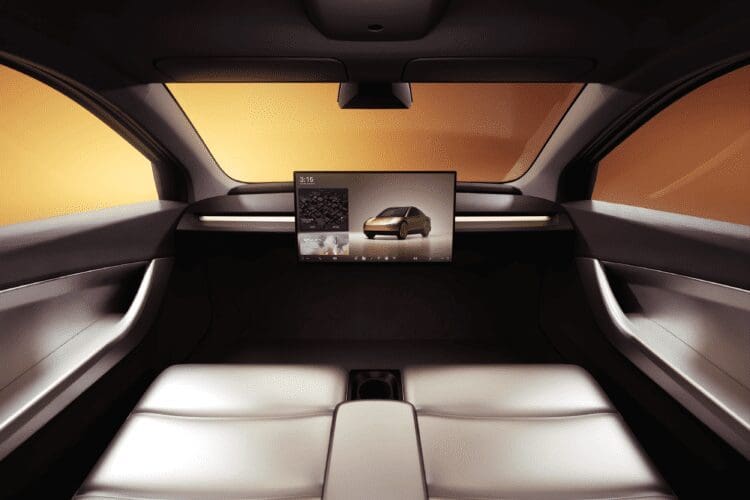
Unlike those superminis, the Tesla Cybercab is purely a two-seater, with space in the front and rear for luggage. In keeping with Tesla’s other cars, the interior is sparse, with a single centre screen the only dashboard feature. The Cybercab doesn’t even have a steering wheel or pedals, reflecting the plan for it to be fully autonomous, although prototypes have been fitted with manual controls for on-road testing.
Tesla Cybercab ‘self-driving’
Tesla claims the Cybercab will be fully autonomous and will not feature any driver controls. However, it hasn’t received regulatory approval for unsupervised autonomous driving and there is still no clear roadmap to its commercial introduction as a driverless cab.
When he revealed the Cybercab, Tesla boss Elon Musk said that before its launch, Tesla would have rolled out unsupervised full self-driving to the Model 3 and Model Y. As per previous promises around FSD, that hasn’t happened.
Tesla Cybercab launch date
There is also no clear plan for when the Cybercab will reach the market. Musk initially said it would go on sale in the US “before 2027”. The EPA listings include an “introduction into commerce” date of May 29, 2026, which is a step towards the start of production, but doesn’t reflect any solid move to market.
Given that Musk has a reputation for over-promising on delivery dates and the regulatory hurdles it still needs to overcome, commercially available Cybercabs could still be some distance away.


