


![Der neue Mercedes-Benz C 400 4MATIC elektrisch.
Energieverbrauch kombiniert: 18,6-14,2 kWh/100 km | CO₂-Emissionen kombiniert: 0 g/km | CO₂-Klasse: A [1]
Exterieur: AMG Line; MANUFAKTUR opalithweiß metallic bright
[1] Die Angaben sind vorläufig. Es liegen bislang weder bestätigte Werte von einer amtlich anerkannten Prüforganisation noch eine EG-Typgenehmigung noch eine Konformitätsbescheinigung mit amtlichen Werten vor. Abweichungen zwischen den Angaben und den amtlichen Werten sind möglich.
//
The all-new Mercedes-Benz C 400 4MATIC electric.
Energy consumption combined: 18,6-14,2 kWh/100 km | CO₂ emissions combined: 0 g/km | CO₂ class: A [1]
Exterior: AMG Line; MANUFAKTUR opalithe white bright
[1] The information is provisional. Neither confirmed values from an officially recognised testing organisation nor an EC type approval nor a certificate of conformity with official values are available to date. Deviations between the data and the official values are possible.](https://b3818668.assetcdn.net/2.0/3818668/wp-content/uploads/2026/04/Mercedes-C-Class-EV-profile--750x500.jpg?lossy=2&strip=1&webp=1)


![Der neue Mercedes-Benz C 400 4MATIC elektrisch.
Energieverbrauch kombiniert: 18,6-14,2 kWh/100 km | CO₂-Emissionen kombiniert: 0 g/km | CO₂-Klasse: A [1]
Exterieur: AMG Line; MANUFAKTUR opalithweiß metallic bright
[1] Die Angaben sind vorläufig. Es liegen bislang weder bestätigte Werte von einer amtlich anerkannten Prüforganisation noch eine EG-Typgenehmigung noch eine Konformitätsbescheinigung mit amtlichen Werten vor. Abweichungen zwischen den Angaben und den amtlichen Werten sind möglich.
//
The all-new Mercedes-Benz C 400 4MATIC electric.
Energy consumption combined: 18,6-14,2 kWh/100 km | CO₂ emissions combined: 0 g/km | CO₂ class: A [1]
Exterior: AMG Line; MANUFAKTUR opalithe white bright
[1] The information is provisional. Neither confirmed values from an officially recognised testing organisation nor an EC type approval nor a certificate of conformity with official values are available to date. Deviations between the data and the official values are possible.](https://b3818668.assetcdn.net/2.0/3818668/wp-content/uploads/2026/04/Mercedes-C-Class-EV-seats--750x500.jpg?lossy=2&strip=1&webp=1)
The Mercedes C-Class EV has debuted with up to 473 miles worth of range and a twin-motor, 482bhp powertrain as it squares up to the new, 500-mile BMW i3.
For the first time since it debuted in 1993, Mercedes is now offering its erstwhile BMW 3-Series rival with an electric-only drivetrain as it seeks to claim a place at the top of the D-segment compact executive EV class.
Mercedes C-Class EV battery, range, and tech
Riding on the same EV-only MB.EA platform as the GLC SUV, the new C-Class EV packs a 94.5kWh battery with a 473-mile range. Meanwhile, its 800V hardware promises charging speeds of up to 330kW, which translates into 199 miles of range in just 10 minutes.
Like the all-electric CLA, the C-Class will be offered with a 400V inverter, which makes it compatible with lower-powered public chargers common to the UK.
Later down the line, Mercedes promises a less powerful, rear-wheel-drive (RWD) model with an i3-rivalling range of around 500 miles, along with other choices of battery and power. These will include a tri-motor AMG car, which will go toe-to-toe with BMW’s upcoming iM3 super saloon, which promises four electric motors and around 1,000bhp.
The MB.EA running gear includes a two-speed gearbox for the rear motor to optimise acceleration and efficiency. All-wheel-drive (AWD) 4Matic cars have a front-axle-mounted motor that kicks in depending on throttle and drive mode. Otherwise, the front motor is disconnected from the drivetrain up to 90% of the time.
Another feature of the C-Class EV is its Airmatic adaptive suspension. Alongside promising S-Class levels of comfort, the system uses real-time cloud data to prime the chassis for upcoming potholes and/or speed bumps. Its rear steering turns the back wheels up to 4.5 degrees left and right to improve stability at high and low speeds.
Mercedes C-Class EV design
Inside, the first-ever electric C-Class is a largely buttonless affair, and the cabin is dominated by a dashboard-wide, 39.1-inch Hyperscreen running Mercedes’s MBUX operating system. The difference between the optional Hyperscreen and the standard-fit Superscreen is that the latter doesn’t get the third passenger display.
Mercedes promises that the C-Class EV will set “a new benchmark for quality, craftsmanship, and comfort” thanks to its use of metal, lighting, and various materials, including vegan and optional Nappa leather.
The seats come with four-way, electro-pneumatic lumbar support, while an optional Sky Control panoramic roof is offset with 162 illuminated three-pointed stars. Top-tier cars will come with a Burmeister 4D Surround Sound system, which fits bass-transmitting transducers into the seats, allowing passengers to “feel” the music.
The C-Class EV shares its bold front end with the GLC, and its distinctive grille is embedded with 1,050 LEDs. Meanwhile, the headlights come with an embedded three-pointed star signature.

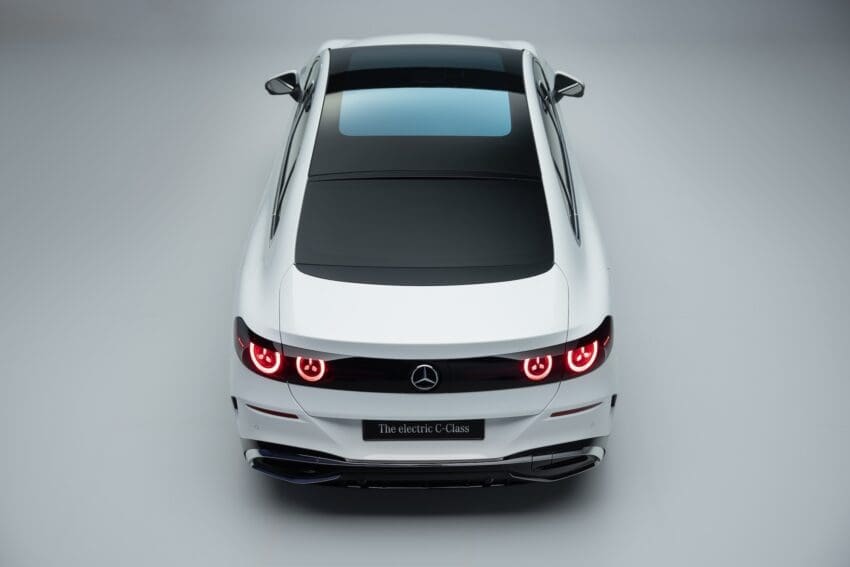
Around the back, the electric C-Class has a “GT rear end” with four tail-lights, once again finished with Mercedes’s three-pointed star in the centre. Their surrounding black surround – along with a high waistline, large wheels, and an extended glassbox – come together to create a fastback design; another first in the C-Class’s 33-year history.
Practicality and pricing
The Mercedes C-Class EV comes with 470 litres of boot space and a 101-litre frunk for charging cables and the like. Mercedes has no plans to introduce a larger estate model, as it claims the GLC is for buyers who want their EV with more space.
No pricing for the C-Class EV has been made public yet, but it is likely to cost around the same as the BMW i3, which is pegged at around £50k. The new electric C-Class is expected to go on sale in the UK this summer, with deliveries made before the end of the year.


