

From the heart of Mid Wales, the gloriously bonkers ‘Moggy’ talks to EV Powered about how Electric Classic Cars is a hobby that got out of hand, why he doesn’t give a monkeys about classic car purists, and why innovation will remain at the very heart of ECC
“Come with me, and you’ll be in a world of pure imagination,” crooned Gene Wilder in the 1971 version of Willy Wonka & the Chocolate Factory. Closer to home and rooted firmly in the real world, Wilder’s romantic “world of pure imagination” can also be applied to the pub beer garden for all four days of the Great British Summer.
But given EV Powered is a motoring publication and the summer months are still some time off, today’s world of wonder is in Powys, mid Wales. It’s a spectacular place.
The drive into the country’s most sparsely populated region is little short of breathtaking; a bellicose symphony of unpronounceable names, rolling hills, and narrow roads. It is, very much, a playground for the keen motorist.
This makes it a fitting base, then, for Electric Classic Cars. Founded in 2015, ECC was the world’s first company to electrify classic cars and give them a new lease of life since 2015.

Sitting in the back of a converted Volkswagen Camper outside the Electric Classic Cars workshop, its founder, Richard Morgan – affectionately known as Moggy – is ready to dive into ECC’s journey from Beetle conversions, to retrofitting Ferrari Testarossas with Tesla powertrains and ruffling a few feathers within the classic car community along the way.
With sideburns that would shame a mid-90’s Gallagher brother and a frenetic energy befitting of any inventor – and rally man – worth their salt, he explains that the cogs started turning for ECC while competing in the British Historic Rally Championship.
“I’ve always loved classic cars, and I was driving in the BHRC with a classic Porsche,” Morgan recalls. “In the end I gave it up because it got too expensive, but when you stop racing, it’s like coming off heroin…at least that’s what I imagine,” he chuckles.
“You quickly get itchy fingers and need something to do, so I decided I wanted to build my own race engine, and put it in one of my VW Beetles to go drag racing. My favourite Group B rally car is the Lancia Delta S4, which had a supercharger and a turbocharger. I thought I’d fit the Beetle with something similar.
“I was designing it in my head, but I’d have had to have designed a set of different wastegates, then when the supercharger runs out of puff, then the turbo kicks in and you have to blend the boost. It’s a lot of effort and a lot of complexity for a motor that’ll barely pull a wheelie…”
Drivetrain agnostic
Around that same time, Morgan came across a “complete nutter” in the United States, who’d ditched their Beetle’s wheezy air-cooled motor, and replaced it with “an electric motor no bigger than a biscuit tin”.
He’s keen to stress that while he’s a classic car enthusiast at heart, he remains a self-described “drivetrain agnostic”. Like previous EV Powered guests, Jonny Smith, Marcus Grönholm, and Nir Kahn, Moggy doesn’t view the automotive landscape as a binary between internal combustion and electric. As long as it’s fun, that’s what matters.

“I realised quickly in my professional career how much power there is in electric motors and stuff, so I thought ‘I’ll give that a go’ and converted my ‘60s Beetle to EV,” he continues excitedly. “I went out of my driveway, turned onto the main road, put my foot down, and was like ‘whooooa, that’s brilliant!’ – petrol’s dead for me!”
“But all of this honestly started as an engineering exercise to keep me busy. As I’ve said many times, it’s a hobby that’s got out of control, and if you turn your hobby into your career, you’ll never work a day in your life. I’m very lucky that I enjoy going to work every morning.”
‘I can make it better’
While starting out, Morgan initially decided “if I’m going to turn classic cars into electric, then they have to be classics with rubbish engines, just like this Camper we’re sitting in now,” he says with a slap of the rear bench.
“I say this with a lot of love for classic VWs, but the engine was a bit pants, to be honest – it had about 40bhp and wouldn’t pull the skin off a rice pudding. The noise was a bit iconic, but that was it. We set out to change that.”

A particular car from the early years that sticks out in the ECC story is a Ferrari 308. Fed up with it breaking down, the owner contacted Morgan and asked him what he can do to improve it. “It’s easy,” he replied. “I can make it better.”
“I can’t think of anything more embarrassing than breaking down on the M1 in your Ferrari,” he says wide-eyed. “Imagine that, all the white van lads driving by and honking – no wonder the bloke had had enough and didn’t enjoy it! That was the first Ferrari we converted to electric, and since then we’ve done five Ferraris, including three Testarossas.”
The Teslarossa and doing the unthinkable
For classic car purists of a certain vintage, ripping the flat 12 from a Testarossa or the boxer engine from a Porsche 911 is an act of desecration. “You can’t do that”, they will puff and blow online. Moggy has a message for them.
“Yeah, I can – too late, I’ve done it now. Deal with it. I don’t give a monkeys,” he says pointedly. “With the Testarossa especially, people look at that car with rose-tinted glasses because it was in Miami Vice. The truth of the matter is, though, that it was a bit rubbish.
“All of the weight – the fuel tank, the engine, the gearbox – was in the back, as was the radiator, and the exhaust. The weight distribution is all off and it just oversteers horribly.

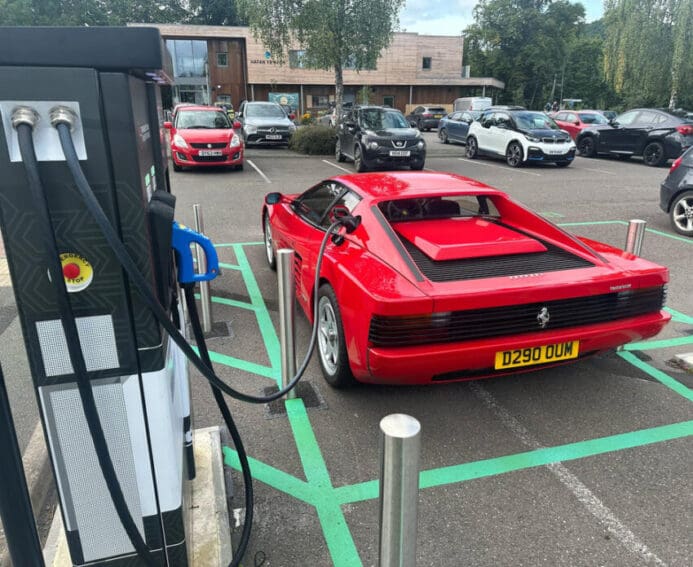
“By fitting the electric motor, it allowed us to keep the car’s weight in front of the rear driveshafts and move some of the weight up front. By the end of it, it was handling like a Lotus Elise and the Testarossa finally drove as good as it looked.
“We actually called that car the Teslarossa, because it had a Tesla Performance drivetrain with 600bhp.
“That was definitely one of my favourite cars we did, because it was so much better than when it was petrol. The amount of hate we got for that was really funny, because most of these people getting angry about it had probably never driven a Ferrari in their lifetime.
“It’s like these nutters who’ve never eaten a pineapple just because they look funny. Pineapples are delicious, right? What I’m saying is, there’s plenty of those types out there who try to convince you that electric cars aren’t the future, despite having never experienced one first-hand.”
The nonsense of nostalgia
Humorous fruit-based analogies aside, Morgan is keen to dispel the notion that a classic car is defined purely by its sound. If you’ve been hanging around these parts long enough, you’ll have noticed that EV skeptics often attribute an electric vehicle’s ‘lack of soul’ to the absence of an engine note.
“When you drive a classic electric car, there’s better weight distribution, better handling, and more power than there was when it first left the factory,” he explains animatedly, countering a light rant with a healthy portion of insight. “As for this idea of a car being nothing without the sound, that’s nonsense because there is one – it’s just this whooshing, Jetson’s kind of noise. It’s different.
“What about deaf people? Just because they can’t hear, are you telling me that they get less enjoyment from their classic car than we do? I don’t think that’s the case. I don’t look through rose-tinted glasses at some of my old Beetles and the racket they used to make.

“Don’t get me wrong, they sounded fantastic, especially those with the open-headed supercharger, but 10 minutes down the road, you’d be like ‘aaargh, where’s my ear muffs’?” At the end of the day, noise is great, but that’s just part of classic car ownership. The advantages of EV conversion definitely outweigh the noise aspect.”
Electric Classic Cars’ mission is also one of preserving classics for future generations. The demand for classic cars from the ’70s to the ’90s is up amongst millennial and Gen-X buyers. The problem is here for Morgan, is that “most of the younger generation don’t know what a Haynes manual is.
“If we make a classic car with a reliable, relatively maintenance-free drivetrain, then that takes the barriers to ownership away. I hope that we’re democratising classics not just for a new generation of car enthusiasts, but for older drivers who want a classic without all the hassle that comes with it.”
Tesla powertrains and an inconvenient truth
As to why ECC’s creations enjoy “hundreds of thousands of problem-free running”, Morgan points to its use of Tesla underpinnings. If you’re no fan of Elon Musk, you might want to brace yourself for an uncomfortable truth.
“There are other drivetrains we could use, but we don’t use them because they’re too expensive,” he says candidly. “Tesla spends tens, if not hundreds of millions on drive unit R&D, which is why they’re brilliant. I think it’s pretty simple why we piggyback off the back of this. They’re also pretty indestructible.”

Yet ECC’s operation isn’t just a case of plugging in the Tesla unit, and off you go. The oil seals and bearings are changed, and limited-slip differentials are added. “We completely recondition them, and address those little foibles,” Moggy explains. “We then test them to ensure they’re good to go.”
What’s next?
“I absolutely love innovating,” so that’s something we’re keen on here,” he says thoughtfully. Stepping away from his mad engineer persona for a second, setting new standards in the electric classic car world is something close to Morgan’s heart.
Since Electric Classic Cars was founded, other similar UK firms have sprung up in parallel – most notably Everrati and Lunaz. Nonetheless, ECC is the one that introduced CCS rapid charging, electric air-conditioning, and – if we listen to Morgan – helped establish a clear set of safety parameters for electric classics by working alongside legislators.

“We’ve worked with the DVLA to establish what you can and can’t do to modify a vehicle, and we’ve also set standards with the Historic Classic Vehicle Association (HCVA),” he explains. “They help ensure that a classic car is converted to certain standards. That means you can add things like isolation monitoring and crash detection systems.
“If you’re involved in an impact, these systems will switch all the high-voltage off, and they’re included in what we do. They’re part of the R100 regulations, which you have to follow when you’re part of the HCVA. Other companies out there might not work to the same standards as we do.”
As for the next chapter in the Electric Classic Cars story, Morgan insists that it’ll continue “pushing the envelope” and points to its new skateboard chassis for use in its off-road models.
For now, though? “I am saving the planet one burnout at a time,” he grins.


