


Speaking exclusively to EV Powered, Renault UK managing director, Adam Wood, explains why the French carmaker continues to go from strength to strength in its EV era.
If you’ve been keeping an eye on our website over the last 18 months or so, you’ll have noticed that Renault has become synonymous with producing some of the best-in-class EVs: Step forward, the Renaults 4 and 5.
On more than one occasion, we’ve already gone over what makes these cars brilliant. Yet beyond the technical capability and sharp looks, there’s something deeper and more human that has made Renault’s revived icons such a vital part of the contemporary European EV scene’s fabric.
“You certainly can’t buy the connections and emotions we’ve built”
Sure, while Chinese newcomers may promise more range and more toys, Wood, who has seen first-hand the French carmaker’s transformation into a European EV powerhouse, feels that the appeal of Renault’s EVs lies in its heritage.
“You simply cannot buy over 120 years’ worth of history, and you certainly can’t buy the connections and emotions we’ve built with people and wider society over time,” the Renault UK boss explains. “I meet so many owners who’ve owned an original Renault 5 who’ve now come and bought the new one.
“It’s just brilliant to hear the stories, to share the photographs, and to share the childhood memories.”

Just ask EV Powered editor Matt. He happily admits that part of his love for his long-term Renault 5 stems from memories of his parents’ original ‘Cinq’, and his mum feels the same, having recently taken the wheel of the electric supermini.
But Renault isn’t resting on its laurels with the success of the R4 and the R5. In fact, leveraging the brand’s emotional equity is part of its product roadmap. Sort of. By 2030, it aims to launch 16 electric-only models in Europe, including a new Twingo and a new electric Clio arriving early next year.
“Cars should bring a smile – they should be fun to drive, and they should be great to look at”
“For us, it’s about continuing to build stories and to build connections with people,” Wood resumes. “I think what makes us unique against some other manufacturers is that we understand the benefits of head and heart appeal.
“Cars should bring a smile – they should be fun to drive, and they should be great to look at.
“We want that ‘Je ne sais quoi’ magic and French flair to come through in our products, because when all cars are electric – and that isn’t too far in the future – that becomes a real differentiator. A car is a huge purchase at the end of the day.”

While Renault has used several historic nameplates to great effect as a part of its EV-focused ‘Renaulution’ strategy, Francophile Wood insists that the brand won’t delve into its history books purely for the sake of it in a cynical attempt to “shift a few cars”.
When Ford adopted this approach with the new Capri it prompted a brutal backlash, and the use of the Explorer name (a long-term staple in the US) has meant little to European buyers. In fact, its performance has been so poor that the Blue Oval has been strong-armed into completely rethinking its European electrification strategy, which, ironically, involves a tie-up with Renault to build a new Fiesta.
“What better car than the R5?”
“We don’t have a blanket strategy to simply revive our heritage nameplates or icons of the past without there being any real modern relevance,” Wood emphasises. “Is there a demand for joyful, fun, accessible electric mobility? Absolutely yes, so what better car than the R5?”
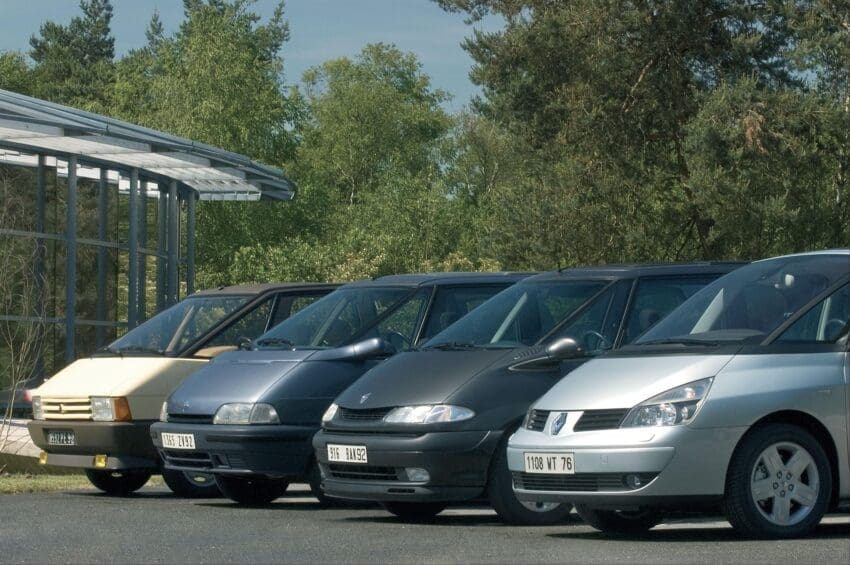
Over the last year or so, the automotive world has noticed an increase in demand for electric MPVs. To name a few, we already have the Kia PV5 Passenger and the Volkswagen ID. Buzz on sale here. Meanwhile, Hyundai promises that its seven-seat Staria will make its way to the UK soon.
Time for the Espace to make a long-overdue comeback, non?


