We were somewhere around Brora, on the edge of Sutherland, when the anxiety began to take hold.
I’d always been aware of our range and the distance to the end of the route, but it was about 60 miles from home that I began to question if we really could make it.
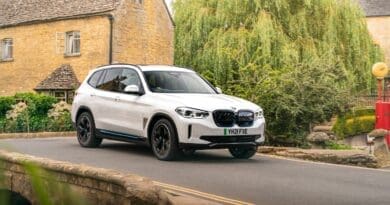
The plan had been an obvious one. BMW launches the UK’s first 500-mile EV, so it should be tested on the country’s most famous 500-mile route – Scotland’s North Coast 500.
Can the BMW iX3 really do 500 miles or is the WLTP figure just pie in the sky?

When I first floated the idea to BMW I was dubious about the reality. I just wanted to see how close it could get. But the BMW bods seemed surprisingly confident that it would manage the whole thing.
So it was that I found myself edging down the north-east coast of Scotland sweating over whether they were right or if I was going to be that clown who breaks down five miles from a charger in search of a headline.
A new class of EV
The iX3 is a landmark car for BMW. While the name has been around since 2020, this car is the first of the Neue Klasse models – the groundwork from which all next-generation BMWs will be built.

It’s built on brand-new architecture in a low-emissions factory in Hungary and is the leanest, cleanest BMW EV yet. In fact, thanks to that renewable-powered factory and massive efficiency savings, BMW reckons the iX3 will reach CO2 parity with the petrol X3 in under two years.
At the heart of all of that, and the remarkable 500-mile range claim is the sixth generation of BMW’s eDrive technology. Everything is new, from the motors to the individual cells in the mahoosive 108.7kWh battery. The Bavarian brand says all the tinkering and tweaking delivers a 20% cut in energy consumption compared to the previous model.
So I immediately set out to stress that to the limit.
I would drive 500 miles…
Starting officially at Inverness Castle, the North Coast 500 is actually 516 miles long and, (you’ve guessed it) runs around the very north coast of Scotland, taking in some of the most stupendous scenery and spectacular driving roads you’ve ever seen.

For the sake of our test, however, we started at a shiny new bank of 400kW Ionity chargers on the outskirts of the city to make sure we started with a full 100%. Duly topped up, the trip computer was showing 512 miles of range in Eco mode. With the Max Range function set, that jumped to a barely believable 578 miles.
I almost laughed at how easy this was going to be.

Even allowing for some optimism on the part of the computer, surely a 60-mile-plus cushion would be more than enough? In fact, so confident was I that I declined to activate Max Range mode and set off for our first stop – lunch on the Applecross peninsula.
If, like we did, you take the clockwise route around the NC500, the first hour or two is actually pretty dull. Lots of flat, tree-lined countryside that, if you’re lucky enough to live in Scotland, feels like the Borders or lowland Perthshire. That isn’t brilliant for sightseeing but did help set a nice relaxed pace and solid efficiency.
After half an hour of constantly watching the odometer and the predicted range, I slipped into the natural pattern of any EV driver and simply got on with the driving and forgot about the fact that we were more than 400 miles from the next planned charging stop.
A couple of hours into the drive, the range depletion was a little ahead of the starting prediction, but nothing dramatic. Then came the Bealach na Bà – the brutal single-track climb and descent from near Kishorn to Applecross with near-20% gradients and frequent stops to let other traffic pass. It was a sharp wake-up call to the challenge that lay further ahead. Over the course of the six-mile ascent, I lost 47 miles of predicted range and clawed back just five on the equally steep descent down to the picturesque hamlet of Applecross.

The “Pass of the Cattle” is the most famous example, but the NC500 is littered with similar steep climbs and descents that take you from the water’s edge to halfway up a mountain in a matter of minutes.
Snaking their way between heather-covered hills, pretty lochans and isolated farmhouses these quickly make trying to monitor your range almost impossible. Even worse than the twisting single-track on the west coast are the long, wide and seemingly endless climbs along the north and east coast. These demand higher speeds to avoid holding up traffic, and sap range at an alarming rate. And, as we all know, you never regain as much on the downhill as you lose on the climb.

That said, the iX3’s regenerative braking earned its keep over the three-day trip. BMW reckons up to 98% of deceleration can be handled by its new setup, recouping exceptional levels of energy for the battery. Over our 500-mile odyssey, it clawed back a remarkable 50kWh – nearly half the battery’s capacity.
Taking it to the Max
With 512 miles predicted at the start of the journey, I had hoped to stick with Eco mode for as much of the trip as possible. But somewhere between the pretty banks of Loch Maree and our first overnight stop in Ullapool, it became clear the range was dropping faster than hoped and I would need to activate Max Range.

This mode caps the motors’ output, switches off the air con and limits the top speed to 60mph. On the NC500, that last matter is irrelevant but lacking air con during a very un-Scottish heatwave did make for some sweaty moments – and not just due to range anxiety.
Halfway there and livin’ on a prayer
The western third of the NC500 is without doubt the most spectacular. Every corner seems to unlock another breathtaking view of jagged mountains formed by the collision of continents, or sparkling blue sea fringed by golden beaches. But it’s also a killer for an EV’s range. At the halfway mark – Drumbeg – even in Max Range mode, the car was predicting just 215 miles left.

Did I steal an envious glance at the i7 charging at Durness? Maybe, but I pushed on, confident that the road would get easier as we headed along the northern edge of the country.
Reader, it didn’t. Having convinced myself the worst of the hills and start-stop single-track were behind us, we spent another good couple of hours winding our way up and down hillsides, stopping to let the tide of rental campervans pass.
Closer to the second overnight stop in Thurso the road flattened and widened but also got quicker. By the time we stopped on the edge of mainland Britain’s most northerly town, the numbers said 21% battery and 119 miles of range left. With 140 miles to cover on our final day…

That said, this time around was still less stressful than my last experience of an EV on the famous route. Then, I’d been nursing a very early Citroen e-C4 between chargers, genuinely worried that it might not make it between stops. This time, just five years later, I was trying to see if I could do it without any stops at all.
Emotionally charged
Nonetheless, I definitely became more aware of the roadside chargers as we wound our way towards John O’ Groats and back down the east coast on day three.

According to various mapping services, there are around 25 chargers – mostly 50kW – dotted along the route, although I found a few more that were active but not listed. That is plenty to let just about any EV make it around the route, but if you’re planning your own EV tour, it is worth noting they’re mostly concentrated on the east coast, with some awkward gaps on the more rugged western side of the country.
Leaving John O’ Groats’ famous white signpost, I confess, my driving got a little more cautious and each new uphill stretch was met with groans of dismay. However, the generally more easygoing part of the route did help my efficiency climb from 4.5 to 4.8m/kWh, bringing a glimmer of hope even as we approached Brora.
The million-dollar question
So, did I make it on one charge?
No.
South of Brora and with 55 miles to go, the car showed just 5% battery and 28 miles left in reserve. Part of me wanted to push on but another part was aware of a charging dead zone just north of Inverness which would leave us with no emergency options if we pushed on.

So a quick 15-minute stop in Golspie gave me an extra 10% in the battery and the confidence to push on back to Inverness, where I reached the Ionity station with precisely 5% battery and 31 miles to spare.
Back-of-a-napkin maths suggests that without that quick stop, I would have ground to a halt 23 miles short of my destination.

That said, the total drive was actually 514 miles, so the car was only 9 miles short of the claimed 500 miles.
Back to reality
I set out on my drive with no agenda. I wasn’t desperate to prove an EV can do the NC500 on one charge, but nor was I trying to disprove BMW’s claimed figure. It was through genuine curiosity and because they seemed like such an obvious fit.
Of course, my competitive streak meant I was keen to manage it, but the fact I fell just short is no great disappointment. The NC500 is not an efficiency-friendly route, and I’m no hypermiling expert. Yet the car still almost made it.

And I was trying something that most drivers won’t. On a normal drive around the NC500, one or two brief lunchtime charges would have been more than enough to see us home.
Perhaps more relevantly, the iX3 proved that, driven normally, more than 400 miles is still easily achievable.
And with the new i3 saloon promising up to 567 miles, maybe there’s still hope that I’ll do the NC500 on a single charge.