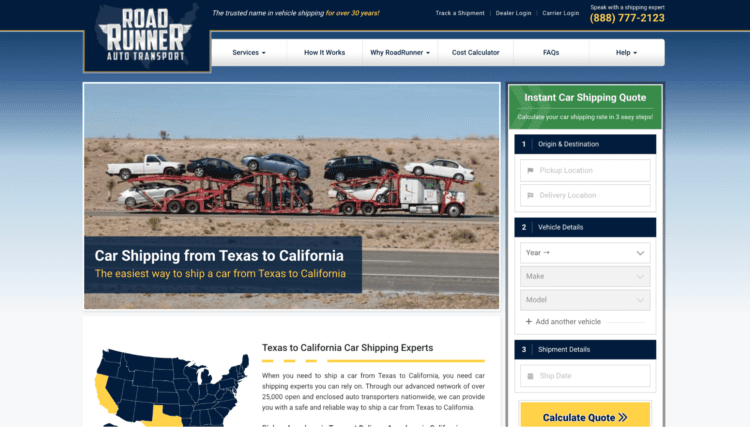
The I-10 lane between Texas and California is one of the busiest auto transport routes in the country.
Carriers run it constantly, which means more truck availability, competitive pricing, and shorter wait times than you’d get on a quieter route.
If you need to ship a car from Texas to California, knowing how this corridor actually operates will save you money and a lot of phone calls.
The route runs through familiar territory, but the pricing and timing logic surprises most first-time shippers.
The route and transit time
Most trucks heading west from Texas pick up loads in Houston, Austin, San Antonio, or Dallas.
Drop-offs cluster around Los Angeles, San Diego, and the Bay Area.
The drive itself is roughly 1,400 to 1,550 miles, depending on origin and destination.
Trucks typically cover it in three to five days once loaded.
Expect the actual on-truck transit to be the short part of the equation.
The pickup window is usually what stretches the timeline.
What the lane actually costs
Pricing on this corridor moves with the seasons.
Winter rates climb when snowbirds head west and demand jumps.
Spring sees the reverse pattern when those same vehicles head back east.
A standard sedan on an open trailer from Houston to LA typically runs somewhere between $900 and $1,300.
SUVs and full-size trucks push higher because they take up more deck space and add weight.
Enclosed transport runs roughly 40 to 60 percent more than open.
A few things drive the final number more than people expect:
- Vehicle size and weight, since full-size pickups and lifted models cost more
- Operability, because non-running cars need a winch and add a fee
- Pickup and delivery zip codes, since rural addresses pull drivers off the main route
- Timing flexibility, where wider pickup windows get better rates
- Trailer type, where an enclosed trailer protects from road debris but costs more
Open vs enclosed on this route
Open carriers handle the vast majority of shipments on this lane.
They’re the standard nine or ten-car haulers you see on the highway.
Enclosed transport makes sense for classic cars, exotics, or anything with a paint job you can’t afford to risk.
For a daily driver, it’s usually overkill.
The I-10 corridor does get desert dust and the occasional rock chip, though most cars arrive in the same condition they left.
Pickup windows and why they slip
The pickup window is where new shippers get frustrated.
Brokers quote a 1 to 5-day window because they can’t promise an exact day until a carrier accepts the load.
Once a carrier is assigned, you’ll get a tighter window, usually 24 hours out.
If you need a hard pickup date, expect to pay a premium for guaranteed service.
Even then, weather or mechanical issues can shift things.
Brokers, carriers, and how pricing gets set
Most quotes you receive come from brokers, not the actual trucking company.
Brokers post your shipment on a load board where carriers pick it up.
This isn’t a bad thing; it’s how the industry runs.
The price you’re quoted is partly a guess at what a carrier will accept.
Lowball quotes often sit unassigned for days because no carrier will take the load at that rate.
A realistic quote that matches current lane pricing gets picked up faster.
Established brokers like Road Runner generally price closer to what carriers will actually accept, which is why their loads tend to move on the booked date.
Inspections and the bill of lading
When the truck arrives, the driver does a walkaround inspection and notes any existing damage on the bill of lading.
You sign it at pickup and again at delivery.
Take your own timestamped photos before the car leaves and right when it arrives.
If anything is different, note it on the bill of lading at delivery before signing.
That’s the document insurance claims hinge on.
Practical tips that save headaches
A few small habits make the whole process smoother:
- Keep the gas tank at about a quarter full, enough to drive on and off without adding weight
- Remove or cover toll tags so they don’t ping across three states
- Pull personal items out of the car, since carriers aren’t insured for them
- Disable aftermarket alarms before pickup
- Leave a spare key with the driver and keep the original at home
The bottom line
Texas to California is a well-worn lane.
The car shipping market on it is competitive enough that you have real choices.
The biggest factor in a smooth experience is matching your expectations to how the industry actually operates.
Flexible timing, realistic pricing, and good documentation at both ends will do more for you than chasing the cheapest quote.