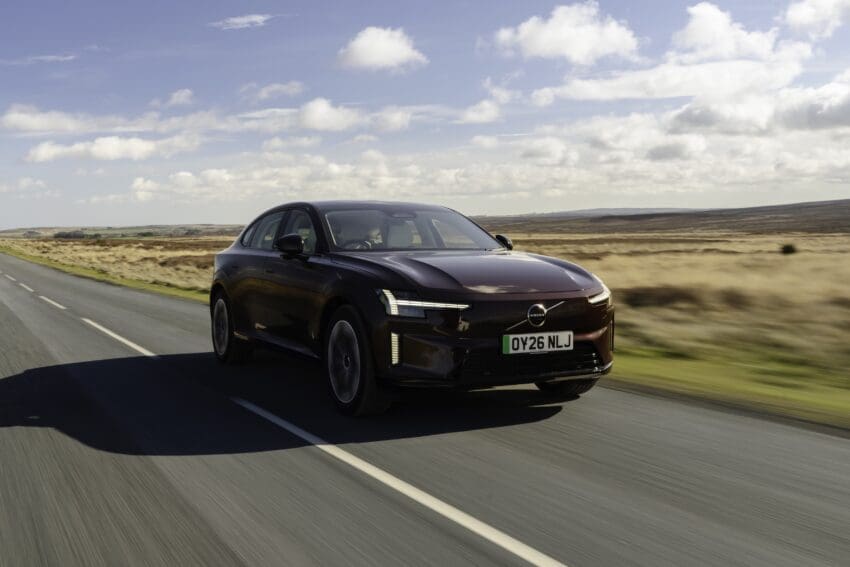
Slick, serene, sluggish
The Lexus ES is everything you'd expect from an electric Lexus - smooth, quiet and comfortable. But its powertrain is well behind rivals
I first drove the Lexus ES when the seventh generation launched in Europe way back in 2018.
Then it felt like a capable but dull hybrid alternative to the likes of the BMW 5 Series and Audi A6. It also felt tarnished by its association with the Toyota Camry.
Now, the eighth generation has landed and as well as being free of associations with lesser cars, it’s also being sold as pure EV for the first time.
In fact, in the UK it’s only being sold in all-electric guise, so I spent a day on UK roads getting to grips with Lexus’s latest executive saloon to see whether the shift to full electrification can help it compete in a segment dominated by the German “Big Three”.
Lexus ES design and interior
The 2026 Lexus ES is still built on an adapted version of the previous model’s platform but has been given a significant exterior makeover to match Lexus’s new “Clean Tech x Elegance” philosophy.

It’s still a big, long (5.2m) and low saloon but there’s definitely a more high-tech feel to it. The ES retains a distinctly Lexus look thanks to the “spindle” front end design that pinches inwards around the now smoothed-off grille area. New L-shaped lights that cut in below the bonnet line, and black lower lighting units, emphasise the traditional Lexus design cue and house adaptive LED units. It’s certainly different from the approach of German and Swedish alternatives.
From the side, there’s a hint of squashed RZ about the profile, along with some quite striking black moulding that’s apparently there to disguise the fact the ES is taller than before. At the rear there’s a neat “boot-less” design which gives the ES a fastback look but retains the traditional saloon lid. Under that, there’s a 512-litre space big enough for a couple of big suitcases or four golf bags.
The new ES is a whopping 16.5cm longer than the old model, and half of that extra length is in the wheelbase, creating more space than ever inside. The result is a massively spacious cabin. Rear legroom is outstanding, with enough for a 6’ 5” passenger to sit behind a driver of the same height and still have plenty of extra knee room. They will be a little tight on headroom, though, but it’s still fine for anyone around the 6ft mark.
A lot of attention has been paid to the rear seats and, in top-spec Takumi grade, the ES offers heated and cooled massage seats with a reclining function and powered “ottoman” leg rest. Rear passengers can also slide the front passenger seat forward remotely for even more space, and there are angled phone mounts and chargers for both rear-seat passengers.

Those in the front also get newly designed seats that are thinner, lighter and more supportive than before. They’re still a little narrow for bigger-built drivers and set oddly high, which gives a slightly perched driving position.
As ever with Lexus, the build quality is impeccable and the material choice interesting. Entry-level cars get faux leather, while higher grades get semi-aniline leather. Those higher-spec cars also get a wonderful pale bamboo finish to the inner door cars which is crafted to let the animated ambient light diffuse through it.
The overall cabin design strikes a pleasing balance between the high-tech overload of its German rivals and the minimalist look of the Volvo ES90. Of particular note are the hidden switches in the dashboard which only illuminate when the car is running. These are similar to the haptic controls on some Kia and Hyundai cars, but the Lexus ones work far better, with a pleasing level of squish beneath the finger that leaves you certain if you’ve pressed it or not.

Lexus ES technology and equipment
Those hidden switches control functions such as the temperature and demist settings, with most of the rest of the car managed via the 14-inch touchscreen.
This is all-new for the Lexus ES and the interface has been designed specifically for European tastes. There are clearer, simpler home screen icons, more easily accessible shortcuts and integration with the 12.3-inch digital instruments. It’s definitely better than previous Lexus efforts, but some functions (especially ADAS-related) still require too many screen presses to reach, and rivals still do it better.
Connected services work with the infotainment system and Lexus Link+ mobile app to allow a wide range of data, security and infotainment settings to be viewed and managed remotely. For the first time in a Lexus, the central screen can now display charging status, which is a welcome addition.
As one of Lexus’s higher-end models, every ES features 19-inch alloys, adaptive LED lights, heated and cooled front seats with memory function for the driver, plus low-energy radiant heaters and a heated steering wheel. Three-zone climate control, a panoramic roof and wireless phone charging are also standard, along with a 10-speaker sound system and the latest Lexus Safety System+. This includes map-connected adaptive cruise control and lane change assist for the first time, along with front cross traffic alert.
Higher grade models add touches such as a 17-speaker Mark Levinson stereo, head-up display and “easy-close doors” along with the rear seat comfort pack and 21-inch wheels.
Lexus ES range, battery and charging
Lexus is only bringing the ES to the UK as a full EV, and it’s only bringing one powertrain – a front-driven 221bhp setup with a 72kWh battery.
Officially, that battery will return up to 361 miles on the Premium’s 19-inch wheels and 329 miles on the 21-inch wheels. I tested the Premium Plus car on 21-inchers and the ES’s real-world range worked out at somewhere between 265 and 285 miles. Efficiency was around 3.7m/kWh against an official 3.89m/kWh.
That’s not too bad a discrepancy between WLTP and real-world, and is probably good enough for many driver’s day-to-day use. The problem is that the equivalent Audi, Mercedes or Volvo offers significantly longer range.

That goes doubly for charging, which is verging on the embarrassing. The Lexus ES has peak DC charging of just 150kW. That means a 10-80% top-up of the comparatively small battery will take 30 minutes.
Rivals offer charging rates of between 200kW and 400kW. That means they take less time to charge than the Lexus, despite all boasting larger batteries as well.
Lexus ES performance and driving
Rivals also all offer more power and torque than the Lexus, which only comes with that one 221bhp/198lb ft front-mounted motor.
It’s the same motor you’ll find in a host of other Lexus/Toyota models and delivers 0-62mph in eight seconds and a top speed of 99mph.
When an i5 can hit 62 in under 4 seconds, or a Volvo in a little over six seconds, the Lexus’s performance sounds a little weedy.
In truth, though, it’s perfectly adequate, and there’s a pleasant linearity to how the ES builds up to speed. There’s enough instant response for urban manoeuvring and enough mid-range torque to make easy, if unremarkable, progress. The brakes lack bite, but this can be addressed by switching up to one of the higher regeneration levels.

The ES isn’t really a car for envelope-pushing driving, anyway, and feels developed for easygoing cruising rather than high-speed dynamics. The steering is quick and precise through a beautifully thin steering wheel, but doesn’t deliver much in the way of feedback. The ES is also a big and heavy car, and you’re away of that size as the speed builds.
More positively, it’s incredibly refined, with genuinely impressive levels of sound insulation and beautifully sorted damping. Regardless of the road conditions, the ES wafts along, isolating occupants with limo-like levels of ride comfort and noise control.
In simple terms, it feels very much like you expect an electric Lexus to feel.
Lexus ES price, trim and rivals
The Lexus ES starts at a competitive £59,345 for the ES 350e Premium.
That allows it to undercut rivals such as the Audi A6 e-tron, BMW i5, Mercedes EQE and Volvo ES90, which all start at north of £63,000. It also partially offsets some of the gap in technical specs.
Above the entry-level Premium model sits the £68,245 Premium Plus, which is expected to be the biggest seller. The range tops out at £72,545 for the Takumi.
Every model gets the same motor and battery, and the only options are 21-inch wheels for Premium and Premium Plus cars (£1,600), plus a choice of paint colours priced at £850 or £1,200.
Like every Lexus, the ES comes with a standard three-year warranty that can be extended up to 10 years through regular servicing. The battery, meanwhile is warrantied for 10 years or one million miles.

Verdict 3.5/5
The latest Lexus ES is a thoroughly pleasant and largely very impressive car.
It is serenely quiet and smooth, built to last aeons and pleasant but uninvolving to drive. It deftly blends clever new technology with more traditional controls for a user-friendly interface and is hugely spacious and wonderfully comfortable.
In short, it’s everything a Lexus should be and traditional Lexus buyers will be delighted by it.
But up against its German and Swedish rivals, its tech specs look pretty weedy. While the ES’s range and power are adequate in isolation, any similarly priced alternative offers more of both, along with significantly faster charging.
For
- Incredibly quiet
- Excellent space and comfort
- Outstanding vehicle and battery warranty
Against
- Only one motor option
- Slow charging
- Divisive design
- Price
- £68,245 (£71,095 as tested)
- Powertrain
- single-motor, front-wheel-drive
- Battery
- 72kWh
- Power
- 221bhp
- Torque
- 198lb ft
- Top speed
- 99mph
- 0-62mph
- 8 seconds
- Range
- 357 miles
- Consumption
- 3.89m/kWh
- Real-world range
- 265-285 miles
- Real-world consumption
- 3.7m/kWh
- Charging
- up to 150kW. 10-80% in 30 mins
- Boot space
- 512 litres