


Does the high-tech Volvo ES90 have what it takes to compete with the German Big Three in the electric executive saloon segment?
I’ll be honest, I approached the Volvo ES90 in a positive mindset from the start. Ever since we had a 740 as our family car, I’ve had a soft spot for the Swedish firm and its non-nonsense approach to quality motoring.
That has run from its “boxy but good” days to the madness of the 850 estate touring cars, and the modern minimalist brilliance of its SUVs.
And while those SUVs have come to dominate its range and sales, Volvo has remained committed to the big executive saloons that made its name, which makes me happy.
The market for saloons (and saloon-adjacent fastbacks) may be relatively small, but at the premium end there’s still some healthy competition. So it makes sense for Volvo to produce a rival to the Mercedes EQE, Audi A6 e-tron and BMW i5, plus the upcoming Lexus ES, especially as it and the motoring world moves toward electrification.

Volvo says it set out to build the ES90 to answer the question “what do drivers want from an EV?”
Its answer: good range, quick charging, good design and good tech – not tech for its own sake.
So, does the ES90 deliver those?
Volvo ES90 design, interior and technology
Volvo is pitching the ES90 as somewhere between a saloon, a fastback and a crossover.
The crossover idea comes courtesy of a slightly higher than usual ride height, but the body shape definitely has more fastback vibes.
It’s quite different from the S90 which it replaces. From the smooth front end with its Thor’s hammer headlights to the softly swept roofline that merges into a very short rear end, it definitely feels more modern. That rear end incorporates a hatchback-style boot lid that gives access to a 442-litre boot, and also features unusual tail lights either side of the rear glass. I suspect this is meant to echo the signature of the EX90, but it’s a little clumsy and leaves the window looking oddly small.
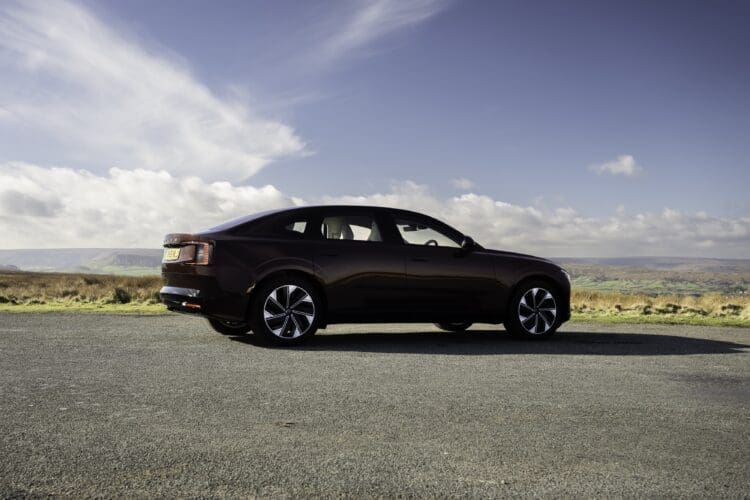
That said, the ES90 looks neater and more compact than the S90, even if at 5m by 1.94m it’s longer and wider, as well as being 10cm taller.
That generous overall length and a mighty 3.1-metre wheelbase translates into a generous amount of interior space. Front seat passengers have more than enough room in every direction, along with plenty of adjustment for Volvo’s supremely supportive and comfortable seats.
Rear passengers are almost as well catered for in the reclining second row. Even the most strapping of Scandinavian types will find plenty of headroom and loads of legroom, although the raised floor leads to a slightly knees-up seating position.
Volvo says it was going for a living room ambience in the ES90 and, like the rest of its electric range, it hits the nail on the head. My test car’s pale wood and cream leather finish created a welcoming, peaceful and light environment that will soothe on long journeys.
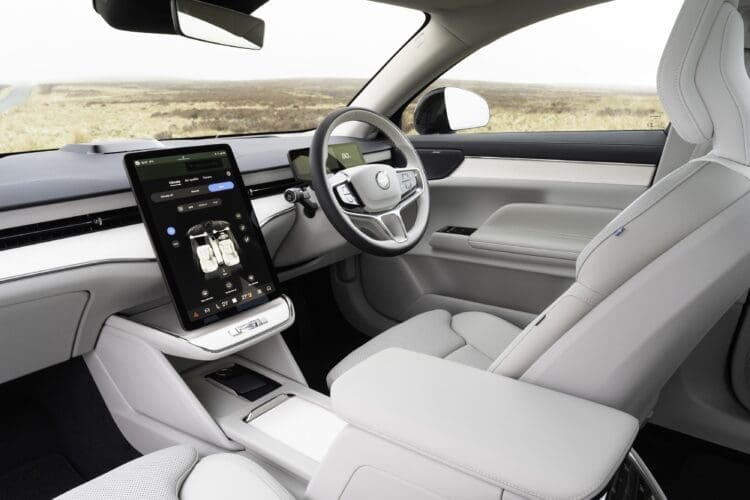
The interior fit and finish is similarly pleasing, with simple, high-quality materials and construction, making plenty of use of reclaimed and recycled materials as part of Volvo’s sustainability push.
Like other modern Volvos, it’s a clean, minimalist look that oozes cool and calm right up until the moment you want to adjust any setting.
Just like the EX90 and EX30, there are no buttons. Every function, no matter how major or minor, is controlled via the Android-powered 14.5-inch touchscreen.
On the plus side, the Google-based OS means that navigation, music streaming and other elements are a piece of cake to manage.
On the negative side it means diving into a variety of menus to do simple things such as deactivate “driver assistance”, adjust the steering wheel position, the wing mirrors or even open the glovebox. There are permanent shortcuts for climate controls and the app tray, plus a contextual bar that throws up different buttons depending on the circumstances. It’s not as frustrating or flawed as the system in the EX30 but it flies in the face of Volvo’s credo of not having tech just for tech’s sake.

Thankfully, despite being built on the same platform as the EX90, the ES90 already has the latest Nvidia central processing system, which means it should avoid most of the issues which led to Volvo performing a digital lobotomy on its flagship SUV last year.
Like the EX90, though, the ES90 doesn’t get the promised LiDAR sensor. Volvo dropped it from the 2026 model year after problems with its supplier. Nonetheless, Volvo says the ES90 offers exceptional safety thanks to its usual focus on passive safety design and smart active functions that range from junction collision mitigation to lane assist which adapts to your driving style.
Battery, motor and driving
Unlike the EX90, the ES90 is launching with 800V architecture. That sounds very geeky but basically means the potential for more power, better efficiency and faster charging.
From launch there are three versions available. The entry point is the rear-wheel-drive model badged Single Motor Extended Range, above which are two all-wheel-drive models – Twin Motor and Twin Motor Performance.

Despite the “extended range” name, the single-motor car gets a smaller battery of 92kWh, providing up to 411 miles of range. Both twin motor variants get a 106kWh battery and a shared maximum range of 438 miles – that’s 70 miles more than a BMW i5 but around 40 miles less than the most efficient A6 e-tron.
The Volvo outstrips all its rivals, however, with charging speeds that peak at 350kW (320kW for the smaller battery) and new battery management software that means charging is cut by up to 25% compared to previous Volvo EVs. Find a suitable charger and a 10-80% recharge will take as little as 22 minutes, or you can add 180 miles in just 10 minutes.
Power from the single motor is a respectable 329bhp – similar to the mid-spec Audi e-tron Performance or entry-level i5. That means 0-62mph in 6.6 seconds and a governed top speed of 112mph.
The regular twin motor boosts that to 443bhp and takes torque from 354lb ft to 494lb ft for a 0-62mph time of just 5.4 seconds. Performance does what it says on the tin, taking the ES90 to an i5 M60-rivalling 671bhp/642lb ft and cutting 0-62mph to just 4 seconds.
I only got the chance to drive the single-motor version but even that feels sufficiently swift. There’s lots of instant shove from the rear-mounted motor and the ES90 will hit motorway speeds in the swift but undramatic fashion of the best executive saloons.
Once at those speeds there’s a touch of wind noise from the oddly wide-set wing mirrors but it’s generally a supremely quiet and refined cruiser with decent road manners. The long wheelbase and wide track means it feels well planted at any speed, and the ride (at least on the air suspension) is generally well composed. Really big bumps will send a bit of judder into the cabin but overall it ties in with the relaxed, easy vibe of the car.
Big Volvos have never been famed for their dynamism and the ES90 is no match for an i5. However, for such a big car it’s actually quite manoeuvrable and neat feeling on smaller roads, aided by light, but not too light, steering.
Volvo ES90 price and specification
The Volvo ES90 range starts at £67,560 for the RWD model in Plus trim. The jump to Ultra takes the price to £77,260 and unlocks the twin-motor options which are a £4,200 or £8,800 price walk.
That means the ES90 Twin Motor Performance tops out at £88,060, which is still £10,000 cheaper than the i5 M60.
Even entry-level ES90 Plus models get LED headlights; 20-inch alloy wheels; heated front and rear seats; heated steering wheel; four-zone climate control; a Bose sound system; head-up display and panoramic sunroof. As expected, the Pilot Assist ADAS system is also standard, along with a powered tailgate.

Plus adds electrochromatic dimming for the sunroof; 21-inch wheels; adaptive headlights; cooled seats all round and a Bowers & Wilkins sound system. It also gains the adaptive chassis with air suspension; reclinable rear seats; massage front seats and laminated side and rear windows for better sound insulation.
Frankly, it’s the kind of all-encompassing spec that you’d expect from a large executive saloon and, pleasingly, there’s no great long options list. All you need to pay for are the seven optional paint shades.
Verdict
The ES90 feels like an EV in the tradition of its famous Swedish predecessors.
It’s a spacious, comfortable, refined and stylish machine capable of cruising long distances and – crucially for an EV – recharging incredibly quickly.
It looks smart, is packed with high-end equipment and is effortless to drive, too.
So, in those ways it delivers all the answers Volvo promised.
It’s just when it comes to “good technology” that it slips up. A slavish reliance on the touchscreen for even the most basic of physical functions feels very much like tech for tech’s sake, rather than anything designed to make life easier for those on board.

Volvo ES90 Plus Single Motor Extended Range
- Price: £77,260
- Powertrain: Single-motor, rear-wheel-drive
- Battery: 92kWh
- Power: 329bhp
- Torque: 354lb ft
- Top speed: 112mph
- 0-62mph: 6.6 seconds
- Range: 411 miles
- Consumption: 3.98m/kWh
- Charging: up to 320kW
Also consider
- BMW i5 – Sharp looking, sharp handling and super high-tech. Beware the endless options list, though
- Audi A6 e-tron – Has the potential for longer range but lacks traditional Audi build quality or Volvo’s charging speeds
- Mercedes EQE – Plenty of badge cachet and lots of variants with impressive range. Can get expensive


