

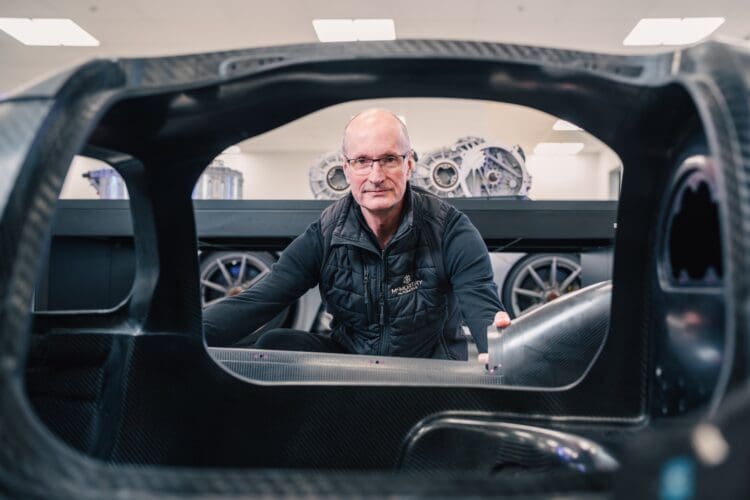


McMurtry’s head of applied technology sales reveals how the British firm is pushing manufacturers to rethink how they go about building their all-electric supercars.
It’s a controversial take, but supercars are possibly the least interesting thing in the world of EVs. Yes, thousands upon thousands of horsepower looks impressive on paper, but in the real world it’s unusable.
Electric supercars: An unpopular opinion
And here’s another unpopular opinion – they look identical. Far lower down the automotive food chain of exotica, early Volkswagen ID cars underwent a bit of a shoeing more than once for looking anamorphic, as do several newer Chinese offerings.
None of the above is unfair.
But hear me out. If you stripped the badges from the likes of the Lotus Evija, the Rimac Nevera, and so on, I’d bet what’s left on my charge card that you’d struggle to tell the difference.
Ultimately, then, the supercar is not my thing. Even in internal combustion land, they never were. At the end of the day, if you gave me the choice between a £2 million, 1,800bhp quad-motor behemoth and a £20k, 81bhp Renault Twingo, then Le Frog will win out every time.
And this isn’t just a case of me spouting off for both cathartic and entertainment reasons.
Enter McMurtry
Speaking from its HQ on an industrial estate in Oxfordshire’s well-heeled Cotswolds, the director of McMurtry Technology, Iain Wight, is explaining in great detail the problems manufacturers face when developing and building an electric supercar.
Founded earlier this year, McMurtry Technology is the British small-batch performance car maker’s innovation and technology arm.
This big-brain division takes intellectual property lifted from its all-electric, record-breaking Spéirling fan car, and sells it to OEMs. This includes everything from McMurtry’s patented ‘Downforce on Demand’ system that generates up to 2,000kg of downforce at the flick of a switch, to lightweight carbon fibre composite structures and equally featherweight, high-performance electric powertrains.
Oh, and if you weren’t sure, the McMurtry Spéirling is *that* EV, which smashed the Goodwood Festival of Speed Hillclimb record in 2022 in 39 seconds flat with Max Chilton behind the wheel. The Briton’s record remains unbroken.

If there’s anyone capable of leading McMurtry Technology, then its Wight, with over three decades of engineering experience in Formula 1, touring cars, and Formula E to his name.
Like many of motorsport’s greats, his ego is inversely proportional to his position, and in the case of Wight, his towering stature. Surprisingly – and disarmingly – he delivers his Scottish accent with an Adrian Newey-like softness.
“If you look at very high performance cars now, they are adorned by aerodynamic devices – and that presents a number of problems,” he explains. “It causes a design problem for starters, and designers hate them because there’s not an awful lot you can do with it.
“The aero creates a lot of drag within the car, and it makes the car platform very large. If you look at some, and I won’t name names, you can barely get in and out of them because it’s so difficult. You can only ever use their performance on track, never off it.”
Performance EVs need not be fat
Despite my best journalistic efforts, Wight won’t be drawn into naming and shaming the latest victims to fall foul of autobesity. However, there’s nothing to stop me, so I’ve run some numbers.
Once again using the Evija and the Nevera, the Lotus measures 4.46 metres long while the Rimac is slightly lengthier at 4.7m. The 1,288bhp Yangwang U9, one of China’s many electric hypercar offerings, is even bigger at just three centimetres shy of five metres. All of these cars are quick, yes. Moon-spinningly quick. But none of them, by any stretch of the imagination, are neither small or nimble. Weight is the reason.
Tipping the scales at 1.84 tonnes, the Lotus is the lightest of the trio. The Rimac is somewhat heftier at 2.15 tonnes, while the Yangwang is 2.5 tonnes, which is more than a Toyota Hilux. The electric version. Let that sink in.
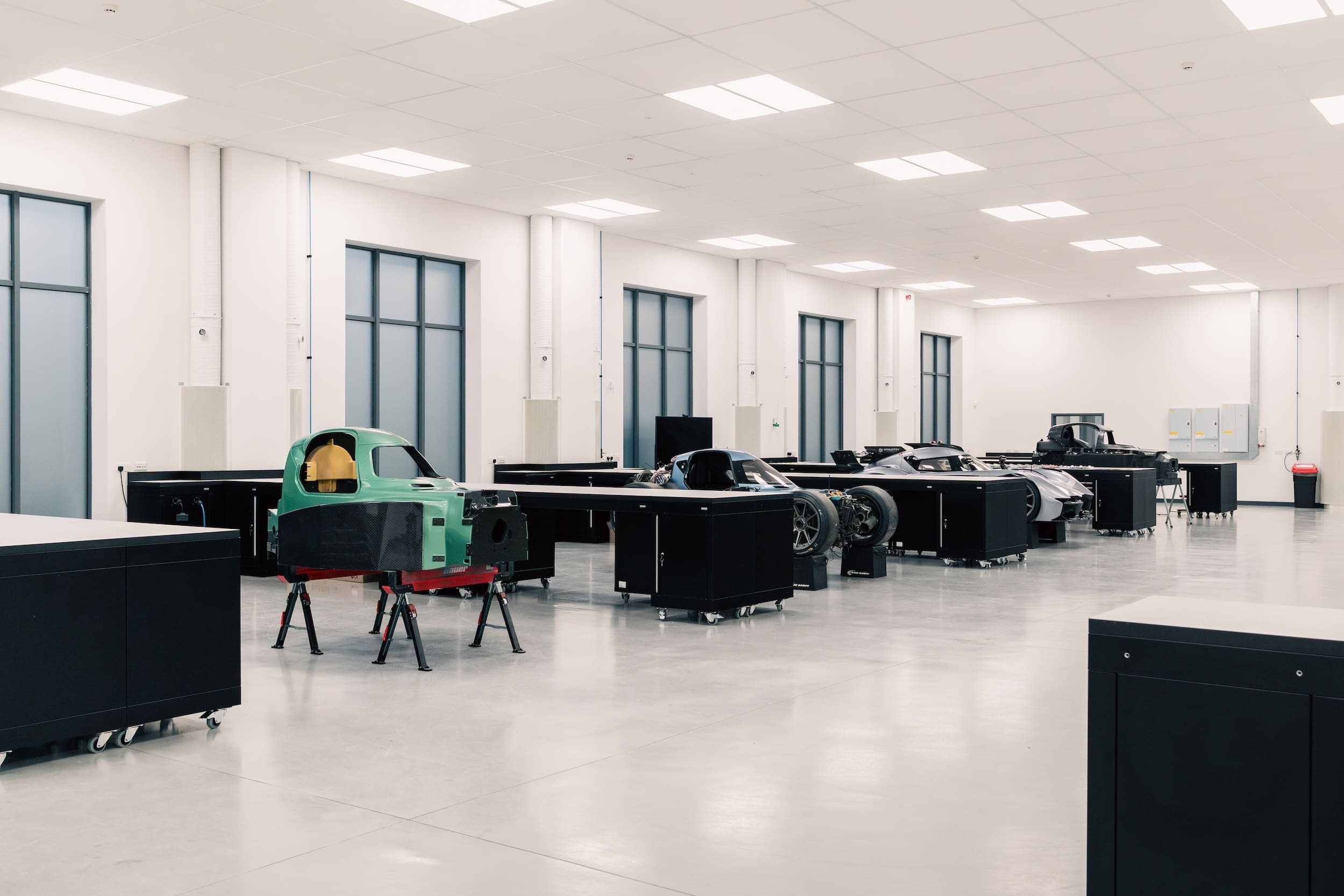
Ultimately, supercars don’t have to be this heavy. On the way up to Wight’s office, proof of that lies in McMurtry’s spotless workshop. Under construction is a now-launched, road-legal, track-ready version of the record-breaking Spéirling, dubbed the Spéirling Pure.
The “three happy bedfellows”
Like the prototype, the road-going car’s fan system generates up to 2,000kg of downforce and a bone-breaking maximum load of 3G in corners. But unlike the prototype, the single-seat cockpit can be trimmed to the buyer’s liking with a broad palette of colours, strips and materials. The one being built is white.
It’s under the skin where the real changes have taken place. A 100kWh battery pack offers up to 30 miles of LMP2 car-matching pace, and there’s a ‘boot’ with enough storage for a HANS device and a crash helmet. Headlights, indicators, brake lights, and a full-beam flash complete the package.
While the Pure’s 2.2-metre wheelbase is two inches longer than its record-breaking forebearer, McMurtry’s first ‘production’ vehicle – as in, it’s road legal, but you wouldn’t want to take it to Aldi – remains an extremely small car at just 3.8m long with the bodywork bolted onto the composite chassis. It’s still smaller than a Renault 5 or a Volkswagen ID Polo.

According to Wight, the key to retaining the Spéirling Pure’s tiny dimensions has been mating the car’s two 500bhp electric motors to its 100kWh battery and McMurtry’s Downforce on Demand technology.
Without getting too nerdy and running the risk of making myself look silly as I’m not an engineer, Downforce on Demand uses two high-speed fans beneath the chassis to suck the car to the ground via an “air skirt”. Unlike the prototype, which requires an external air bottle, the Pure is fitted with an onboard air compressor, allowing the skirt to be retracted from inside the car.
Wight describes the coming together of the electric motors, the battery, and Downforce on Demand as “three happy bed fellows”.
“You can run a fan downforce system from a combustion engine, but you would need to have a battery in it to provide you with a reservoir of energy that you would then charge and discharge through the fan system,” he explains. “When you have an EV running a fan downforce system, it all ties in together, because you’re using the same energy source for your traction motors and for your fans. You’re all running at the same voltage effectively, and it’s all integrated – there’s no imbalance or anything between.”
The integration between the motors, the battery, and the fan places the Spéirling Pure in an virtuous upward spiral, meaning McMurtry is able keep dimensions within the framework of a traditional sports car of yore, albeit one with blistering performance.
Redefining ADAS
While the Pure is no Caterham 7, its 1,350kg kerbweight and 1,000bhp ensures it can compete with much bigger, much more expensive machinery. With a £995,000 starting price, it’s somewhat of a bargain, and its 0-62mph time of 1.5 seconds ensures it’s quicker in a straight line than the hardcore £2.3m Rimac Nevera R.
Such is the curse of the ‘car guy’, the urge to bang on about performance figures is hugely overwhelming, and it’s something Wight says he could “do for at least another hour”. Nonetheless, the engineer steers the conversation in the most unexpected of directions – and that’s using the Spéirling Pure’s fans as an alternative safety device.
“Imagine you’re driving on a motorway or something – it’s poor conditions, maybe fog, and you end up in a dangerous situation,” he hypothesises. “There’s a pile-up ahead, and you need to minimise your braking distance – we can deploy the downforce system incredibly quickly and stop the car really quickly.

“Now you’re probably going to say, but the person behind you will hit you. Well, I’d rather have a rear impact than a front impact into something, so in theory, you could use a safety device as well.”
Without a doubt, using fan tech as a replacement for an overly intrusive ADAS system is something a long way off, if not an extreme flight of fantasy. Return to the Spéirling Pure’s most likely natural habitat of the track day, however, and it’s a tried-and-tested concept.
Don’t forget that for their £995,000, Spéirling Pure owners are privy to all sorts of perks including track driving lessons with McMurtry’s team of professional peddlers, and the opportunity to participate in a variety of regional competitive events including the USA’s Time Attack series, and Time Attack Masters in Europe.
Once again, the floor belongs to Wight: “I started thinking about using fans as a safety device last year,” he says. “We were chasing the lap record on the Nürburgring short configuration with Max [Chilton], and he spun going into turn 13, which is a horrible corner – it’s a real 180-degree left-hander with a gravel trap wall.
“His corner entry was at 2.7g, which is basically the same apex speed as Formula One qualifying when they used it. He didn’t go off the track, and it’s the most boring video you’ll ever see. He basically loses the car and then he stops – that’s it. We timed it. It’s 1.3 seconds from when he lost control of the car to when full control was regained.
“When you’re sideways on with a fan downforce system, you don’t lose your aerodynamic platform – you retain your grip right down to zero speed. So that means that if you wanted to buy a high performance car that has wings on it and drive it at speed, you have to work your way up to that very slowly.
“Because of the way that the aerodynamics work, you have to go faster to make them work. And that’s very scary for a normal driver. For a race driver, it’s something that they work up to. With our car you can get in the car and you can enjoy that downforce at any speed.”
F1 driver-approved
While huge downforce and ground-effect aero are some way off of entering the mainstream, the trend of small, all-electric performance cars is very much here, and it’s not just McMurtry.

Cue Longbow; step forward SCC; and as soon as January next year, we’ll have an all-electric Alpine A110. In fact, F1’s Pierre Gasly even described the latter as “really enjoyable” at this year’s Goodwood Festival of Speed.
With the likes of McMurtry driving innovation and electrification getting the thumbs up from a Grand Prix race winner, what was that about EVs being boring?


