


The Nissan Leaf has once again been named the UK’s most reliable electric car by one of the country’s biggest warranty providers.
Warranty Services Group (WSG) reported that between January and December 2025 the groundbreaking Japanese EV recorded the lowest claim rate of any models covered by its policies.
Although it’s one of the UK’s longest-lived EVs, WSG reported a claim rate of just 1.52% for the first and second generations of Nissan Leaf, less than half of the next nearest model. This suggests that despite being up to 16 years old, the pioneering mainstream EV is standing the test of time.
Encouragingly, the most common faults also had nothing to do with the Leaf’s electric powertrain but were associated with ADAS systems, suspension components and steering wheel controls – all issues that also affect petrol and diesel cars.
In fact, the data shows that just one of the five most common EV warranty claims related to an EV-specific problem.
Behind the Leaf, Audi’s original E-Tron SUV was the second most reliable electric car in the UK – with a claim rate of 3.23% – ahead of the Vauxhall Corsa Electric, which recorded a claim rate of 4.76%.
As a specialist in providing cover after manufacturer warranties expire, WSG’s list features a heavy weighting towards early EVs. In fourth place is the Ford Mustang Mach-E, which launched in 2020, just ahead of the Tesla Model 3, which has now been on sale for seven years.

While the Mach-E proved among the most reliable electric cars it also had the most expensive average repair cost, at £2,242. It’s important to note, however, that with a relatively small sample group one high-cost repair, such as a battery replacement, can skew the average figure.
Although the Model 3 proved a reliability winner, the older Tesla Model S is the UK’s least reliable EV, according to the WSG data for 2025.
The large saloon, which has just been killed off, recorded a claim rate of more than 38%, and an average repair cost of £1,160. The related Model X was the third-least reliable car on WSG’s list, with a claim rate of 23.5%. The two American offerings were split at the bottom of the table by the first-generation Mercedes EBQ, with a 33% claim rate.

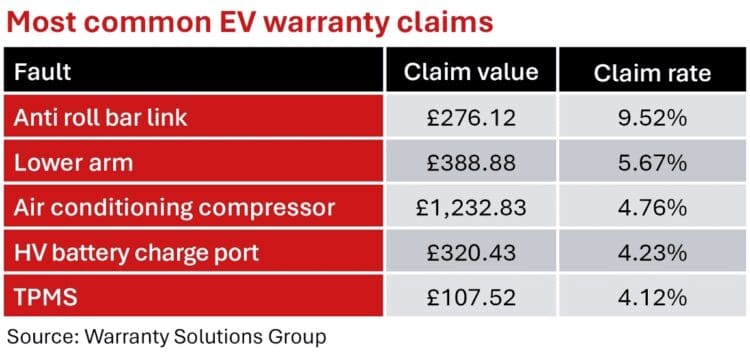
Most common EV warranty claims
The full-year data shows that the majority of the most-common repair claims for EVs did not relate to any EV-specific elements.
Of the five most common claims, just one only affects EVs. Charge port faults were the fourth most-common claim, and accounted for 4.23% of claims with average repair costs of £320.
Ahead of them were two separate suspension elements and air conditioning compressors, with tyre-monitoring systems rounding out the list of most common claims.
While the WSG data provides high-level insight into EV reliability, it is important to note that it is a small sample group and only covers 16 all-electric models for which it provides aftermarket warranties. Even in the last six months, some of the data has changed significantly. The coming years are likely to see the situation shift as manufacturer warranties expire on a growing number and variety of models and secondhand dealers look to provide aftermarket warranty cover for customers.
Martin Binnee, operations director of WSG commented: “Clear differences between makes and models show that electric vehicles cannot be viewed as a single category, and that informed conversations around maintenance, protection and long-term costs have become more crucial than ever.
“At the same time, the data reinforces the importance of looking beyond headline running cost savings when assessing electric vehicle ownership. While many EVs are proving dependable, the cost of repairs can be significant when faults do occur, particularly on vehicles with advanced systems or premium positioning.”


