


After six years in the making, Ferrari has revealed the exterior design and full technical details of its first dedicated all-electric model named the ‘Luce’, meaning ‘light’ in Italian.
Maranello’s Formula 1 drivers, Charles Leclerc and Lewis Hamilton, took the wraps off the much-anticipated car at an event in Italy’s capital, Rome, where it was confirmed with four electric motors, 1,036bhp, and a 329-mile range courtesy of a 122kWh battery.
Pricing for the Ferrari Luce EV has yet to be confirmed, but it is expected to go on sale in continental Europe for around €500,000 when it arrives early 2027. The car is set to head to the UK that same spring, where it will command a £440,000 pricetag.
Ferrari Luce EV performance and powertrain
The Luce’s rear-biased quad-motor setup produces a combined output of 739lb ft of torque, with the rear motors generating 416bhp and 262lb ft each. Those up front make 141bhp and 103lb ft, to produce a total bhp figure of 1,036 electric horses.

The Luce will launch from 0-62mph in just 2.5 seconds and top out at 192mph. Its radial flow, permanent magnetic synchronous motors lean into Ferrari’s illustrious motorsport heritage, and are derived from those used in the hybrid powertrains of the Le Mans-winning 499P prototype and its mild-hybrid F80 hypercar.
Thanks to in-wheel motor tech, a torque vectoring system kicks to improve agility and stability, and the car switches from all-wheel-drive (AWD) to rear-wheel-drive (RWD) in Range mode by disconnecting the front motors. For the rest of the time in Tour and Performance settings, the Luce is AWD.
Battery and range
The Luce’s battery is a 122kWh unit designed and built in Maranello, and integrated into the car’s floorpan.
Weighing 630 kilograms, the battery comprises 29% of the Luce’s 2,269 kgtotal weight. Thanks to its in-house developed 800V electrical architecture, Ferrari promises an ultra-rapid charging speed of up to 350kW. Meanwhile, the range is 329 miles from a single charge.
Design
The Luce’s powertrain isn’t the only first for Ferrari. It’s also the maiden four-door, five-seat model in its 86-year history. Unlike previous Ferraris, the Italian brand has moved away from compatriots Pininfarina and Bertone to pen the car inside and out.
Instead, Maranello employed the services of LoveFrom, a design agency founded by industrial designers Sir Joni Ive – the designer of the iPhone, the iPad, and the iMac – and Marc Newson, another former member of Apple’s crack design team.
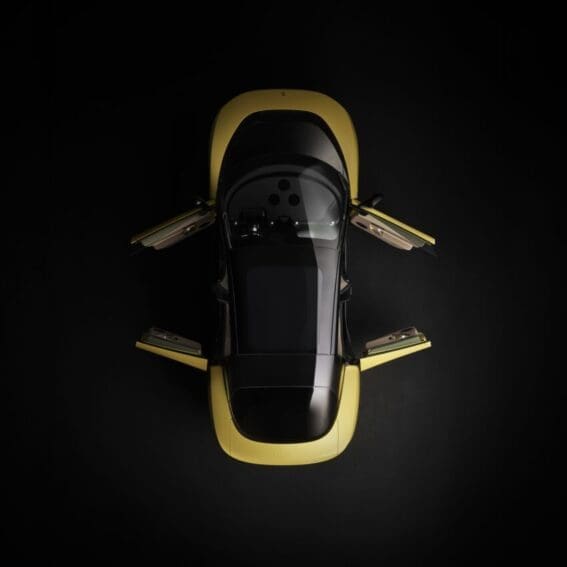
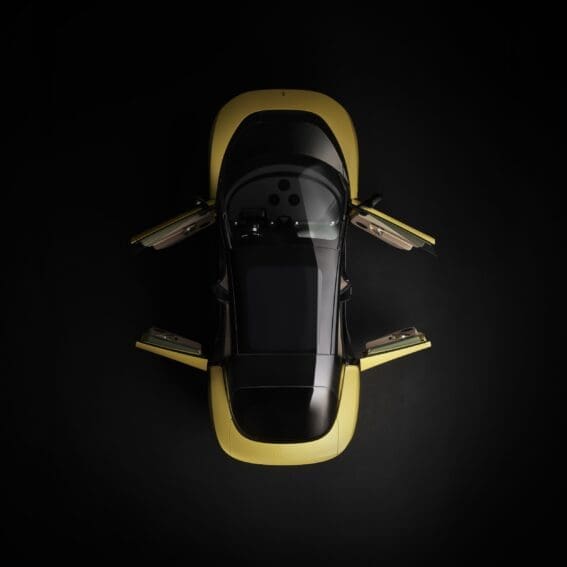
Unlike the Purosangue, the all-aluminium Ferrari Luce EV isn’t an SUV. Instead, it’s offered as a five-metre by 1.9m raised fastback in a way not dissimilar to the Polestar 4. A two-piece floating glasshouse sits atop an aerodynamically-smoothed, minimalist body, which is offset with floating spoilers front and rear to return an unquoted drag coefficient. Aero wheels are also key here.
Nonetheless, Ferrari promises this to be the lowest of any of its cars to-date. Despite sparking controversy online, the striking design will not influence the rest of its line-up, meaning the dramatic visuals of the Testarossa and the elegance of the Amalfi will remain across non-electric models. With a 597-litre boot, the Luce is also the most practical Ferrari yet.
Ferrari Luce interior
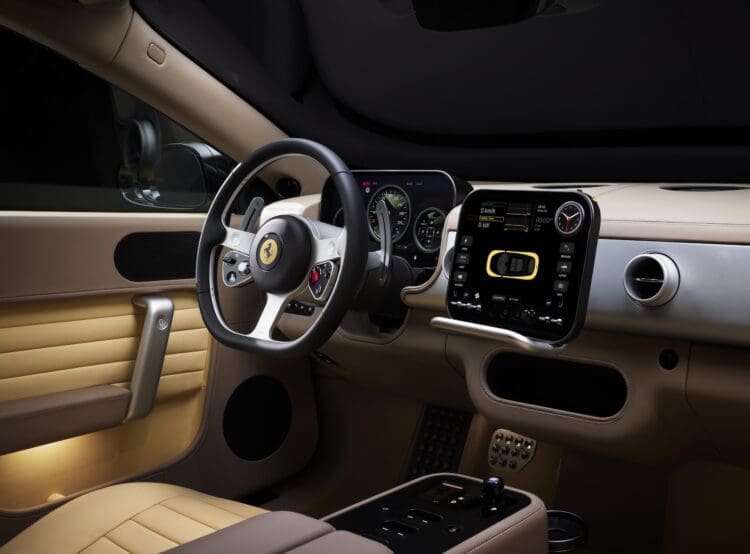
Given its designers’ backgrounds, the Luce’s cabin is heavily inspired by Apple, with swathes of aluminium and strengthened glass. Moreover, the movable 10-inch centrally-mounted touchscreen bears more than a resemblance to an iPad.
Sitting in the top right corner of the screen is a clock with physical dials but a digital face, allowing it to be converted between either a compass or a laptimer. In a break from current trends, the Luce relies heavily on physical switchgear, and the cabin uses them for car controls, including the climate control and infotainment.
The 12.5-inch driver’s instrument binnacle combines the past with the present with three separate dials, created using two custom-made, wafer-thin Samsung OLED screens placed atop each other and convex glass to create an analogue effect.
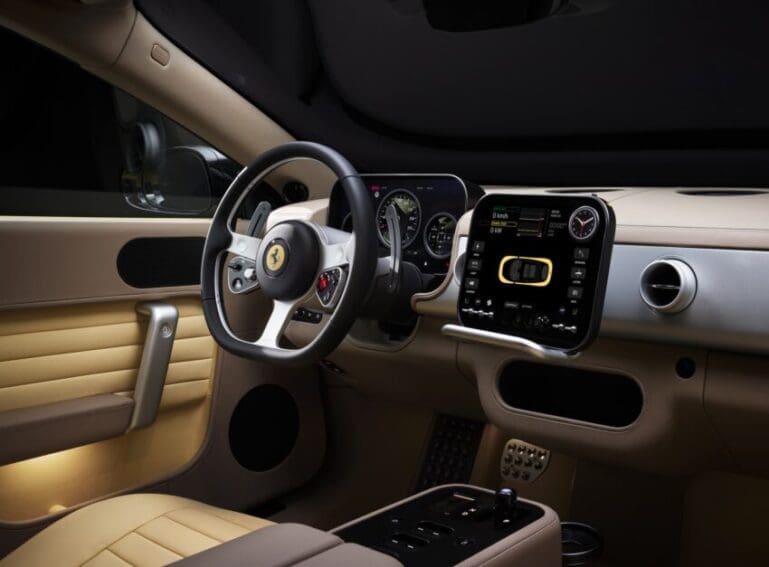
Despite appearing to be plastic, the black surface surrounding the Ferrari Luce’s driver setup is an OLED screen displaying warning lights, turn-by-turn navigation, and the shifting light usually found atop newer Ferrari steering wheels. Simulated engine sounds are also on tap, but they won’t hark back to Ferrari’s screaming V12 or V8 motors.
The needle for the centrally positioned digital odometer is actually a physical component, as are the switches on the manettino on either side of the steering wheel – these control each of the electric modes and powertrain settings, and the paddles behind the steering wheel manage the car’s torque.
Conjoined to the driver display, the three-spoke, thin-grip wheel is a reference to the Nardi-designed unit fitted to some of the most iconic Maranello cars in history.
A ‘floating’ centre console appears to be finished largely in pure leather and glass, and atop it sits physical switchgear to control the boot, windows, and central locking. Like the rest of the cabin, the key is fashioned from aluminium and glass, with its own front-of-console holder. The inverted-L-shaped shifter is also crafted from the latter.
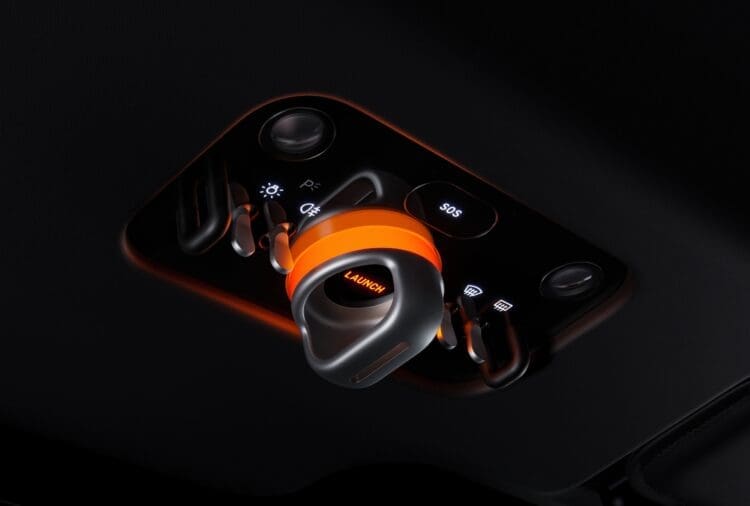
The Luce’s launch control system is activated by pulling down a roof-mounted grip above the driver and is flanked by toggle switches for exterior lighting and defrosting the front windscreen and rear window.


