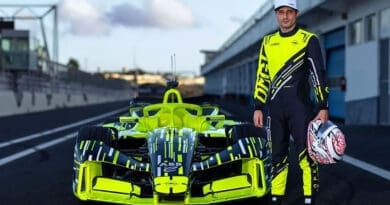
Alejandro Agag has a number in his head, and that number is one minute and eight seconds.
The Formula E founder and chairman wants his electric single seaters to lap Monaco quicker than a Formula 1 car, and he has given himself three to five years to do it. Speaking at FII PRIORITY Europe 2026, he called the moment “the singularity event”, the point at which electric racing stops chasing and starts leading.
“The pole position in Monaco, the fastest lap in Monaco, is one minute zero nine seconds, that’s Lando Norris’ fastest ever lap in Monaco,” Agag said. “We’re hoping to do one minute zero eight seconds. So one second faster than Formula 1.”
One second is not a landslide. Agag knows that. He also thinks it is plenty.
“One second faster, it’s enough for us to show that electric cars can be that,” he said. “And then I’m sure that Formula 1 will do 1:07. So there will be this challenge between Formula 1 and Formula E.”
The hardware is arriving to back the boast. Formula E’s Gen4 car brings 600kW, some 815bhp, permanent all-wheel drive and a claimed 1.8sec 0-60mph launch, and British fans get their look at it when the London E-Prix moves to Brands Hatch for the new era.
Formula 1, meanwhile, is busy arguing with itself. This season’s regulations split power roughly 50/50 between combustion and electric, and Agag is blunt about how that has landed in the paddock.
“They are not happy with it,” he said, “and the president of the FIA, Mohammed Ben Sulayem, wants to go back to V8. So in four years Formula 1 will be completely going back to combustion, which is, I think in my view, where it should be. Because Formula 1 is the pinnacle of combustion and fossil fuels, and we will be fully electric.”
That timeline is Agag’s own. The FIA has publicly pointed at 2031 for a V8 return, with a smaller electric component alongside it. Either way, the two championships are steering hard in opposite directions, and Agag is delighted about it.
Business first, environment second
Anyone expecting a lecture about saving the planet will be disappointed. Agag is refreshingly unsentimental about why Formula E exists at all.
“I would love to say the reason to create Formula E was that we were environmentalists,” he said. “Of course we do care about the environment. But the main reason, and I think if you don’t have a business case for anything it doesn’t have a future, is that we thought there was a big opportunity for business on a greener version of motorsport.”
The nudge came from a sponsor who told his combustion team it was walking away from Formula 1 on sustainability grounds. Twelve seasons later, Agag insists the series is in good shape, though he is candid that growth stalled once Formula 1 rediscovered its mojo. Bernie Ecclestone, he says, let Formula E grow early on precisely because he did not rate it as a threat. Then came Drive to Survive.
Mixed teams, robots and hydrogen
Agag’s other projects follow the same logic. In the E1 electric powerboat series and in Extreme E, every team fields one man and one woman, an idea lifted straight from mixed doubles at Wimbledon.
The results have been striking. “The first season was 1.4 seconds on average, the fourth year was 0.3 seconds on average,” he said of the gender gap, a 70 per cent reduction achieved simply by giving both drivers identical machinery and identical seat time.
On artificial intelligence, he is relaxed. Roborace, the driverless series he backed with cars styled by Tron designer Daniel Simon, flopped for a simple reason. “Nobody wanted to watch them. People want to watch two humans fighting with each other, going, making the risk.”
Monaco, then. One second. The clock is running.