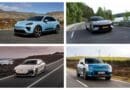


Dr Andy Palmer exclusive: “Chinese EVs have completely eaten our lunch”
The man responsible for the Mk1 Nissan Leaf tells EV Powered about what Western carmakers can learn from China while outlining his plans for an affordable EV-driven future.
In the automotive world, there are an awful lot of voices making an awful lot of noise and fighting to be heard. Especially when it comes to the transition to electric vehicles. But some voices carry more authority than others, and when someone like Dr Andy Palmer speaks, it’s worth listening.


Responsible for overseeing the development of the groundbreaking Nissan Leaf, the now 62-year-old helped make EVs a mainstream proposition for the first time. He also reversed Aston Martin’s fortunes in just under six years. Under Palmer’s leadership, “the once perennially loss-making company” introduced four new core models, including the DBX, Aston Martin’s best-selling vehicle to date.
But Palmer isn’t here to talk about his past achievements. What’s done is done, and in the spirit of any visionary, the “Grey Cardinal of the EV world” – a term he is keen to downplay – has his eye firmly on what’s next on the EV landscape.
Looking East
Given BYD’s current status as a global best-seller, and closer to home, the Jaecoo 7’s achievement of becoming the UK’s best-selling car in March this year, his attention is fixed on the meteoric rise of the Chinese automotive industry.
“Look at China, you’ve got to admire what they’ve done – they’ve completely eaten our lunch,” he chuckles. “Back in 1992, when they came up with the idea of New Energy Vehicles (NEVs), basically electric cars, they asked themselves: ‘How do we catch up with Western carmakers, and then overtake them?’


“Well, first of all, we have to learn how to make cars, so let’s create joint-venture companies with Western manufacturers. That suited us, because if you wanted, broadly speaking, to sell cars in the Chinese market, you had to make them there.”
At the time of writing, the Sino-Western joint ventures are numerous. Stellantis and Leapmotor are happy bedfellows. Volkswagen has paired with Xpeng to pursue its ‘in China, for China’ strategy, while Audi has launched its confusingly named AUDI brand with the help of Chinese automotive giant SAIC for the domestic market.

“As the years passed, China learned how to make cars from their Western partners, then they started dominating in their own market,” Palmer continues. “They got to scale, meaning they got their costs down, and that allowed them to export.”
The result of that is the tide of low-priced Chinese-made EVs flooding UK and European forecourts and stealing sales from the “legacy” brands we’re all familiar with.
Pushing boundaries
It’s a bleak picture Palmer paints. While China was developing its car industry alongside becoming the world’s second-largest economy behind the United States, Western carmakers found themselves “really on the back foot”.
While a fine line exists between arrogance and complacency, Palmer doesn’t feel the former is why China has become “five to 10 years ahead of the West in terms of making electric vehicles”.


“Why would you kill the golden goose?” he asks rhetorically. “The European and American manufacturers have a 100-year history of making internal combustion engines and making them well. Why change that?
“Meanwhile, China has started from pretty much nothing, and they’ve been playing 3D checkers while we’ve been playing chess – they’ve totally leapfrogged us. In an industrial space, there’s always someone pushing the boundaries, so the next big thing isn’t today’s battery space, it’s tomorrow’s.
“For Western carmakers to survive, we have to think about what these boundaries are, and how we can push them to make the next generation of cars.”
Learn from the best
It’s at this point that I ask Palmer whether it’s a case of manufacturers listening to him.
Again, rather modestly, he downplays his importance as a leading EV advocate. Nonetheless, he addresses the elephant in the room for European and American carmakers.
“Just like the Chinese did with us 30 years ago or so, we’ve got to find that same leapfrog strategy, which may well be inclusive of collaborating with Chinese manufacturers,” he says pointedly.


“There is that necessity to learn now, and it sounds strange, to learn from the Chinese and accept that companies like CATL, a battery maker from China, are far ahead of the capabilities we currently have in Europe.”
Another example is in the charging sphere, where BYD is on the cusp of rolling out its megawatt-strong ‘Flash’ charging network across the UK. When it arrives, it’ll dwarf the Tesla Supercharger network’s fastest-charging speed by an enormous 1,250kW.
Yet it’s not just Western manufacturer complacency and China’s nous that have put the Chinese automotive industry in its current position. Since the mid-20th century, the UK has shifted from manufacturing towards a service-based industry.

As successive governments hollowed out UK manufacturing from the 1960s onwards, China went the other way. While the service sector now accounts for 81% of the UK’s output, China has become the world’s foremost manufacturing superpower.
In car terms, as Palmer explains, this has allowed China to develop new products and export them to the West. “You can’t just have a service economy, because you’ve got to make things to develop,” he stresses. “That way, you control software, batteries, and next-generation chemistries.”
“I don’t think Western carmakers are a lost cause, though,” he adds with a touch of optimism. “Volkswagen has said ‘yes, we know what we need to solve in this space’ and I think BMW is a good example of a company that has recognised the need to change.”
EVs need to be better and cheaper
For all his successes, Palmer is far from a diehard EV evangelist. While he drives a VW ID.7 as his daily, his garage, among others, comprises a Caterham 7 that runs on synthetic fuel, and an Aston Martin Valkyrie – one of the cars he oversaw during his tenure at Gaydon.
It comes as little surprise, then, that he adopts a pragmatic approach to converting UK motorists from internal combustion to electric daily drivers. Given rising fuel prices as a fallout of the Iran War, his rationale behind financial incentives is especially pertinent.
“Simply telling people that their car is green and it’ll save the planet simply won’t work,” Palmer outlines. “We’re selfish by nature as humans, and we want to take care of ourselves and our immediate loved ones. First and foremost, taking care means paying the bills and putting food on the table.”

What, then, is the secret to persuading more motorists to switch to electric?
“To move humanity towards decarbonisation, carmakers must make EVs the best technology possible for most of us, and you’ve got to make them cheaper,” he explains. “That means scaling up, which is what we can do via the joint ventures we touched on earlier.
“Most of all, though, an EV has to be much cheaper to run than an ICE, otherwise there’s no point. This is the biggest challenge.”
Pointing to his work at Palmer Energy, a firm specialising in the design and manufacture of battery energy storage systems, he envisions an ecosystem where EVs are on par with an internal combustion car to buy, but free to run.


“My North Star is to democratise electricity generation, and to do that, you’ve got to be able to trade energy with the grid, and you’ve got to create your own energy,” he continues. “Generally speaking, that means using solar to take electricity into a battery, which could be your car if it has vehicle-to-grid (V2G) functionality.
“You buy it during off-peak hours when it’s 7p, then sell it back to the grid at 70p. While you’re using your car’s battery for energy trading, you’re also generating at least 50 miles worth of electricity for free, and that’s more than most people need daily.
“Here is where I think OEMs have it wrong. Instead of creating affordable vehicles, they focus on low-carbon ones. When someone comes up with an EV that’s the same price as an ICE, you’ll see the volume come through, because at the end of the day, anyone buying that car will get cheap, if not free running costs.”
And there you have it. Dr Palmer has spoken. Perhaps the car industry should open its ears.