

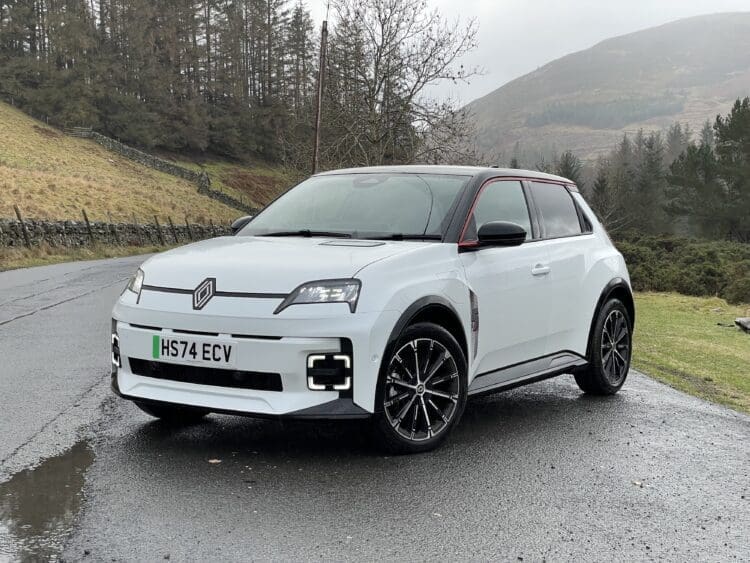
The Renault 5 undoubtedly has plenty of charm, but how does it deal with the rigours of everyday life? We’re running one on long-term review to find out.
Month 3 – Big differences
This month I’ve had cause to refuel my stupid weekend toy. The middle of another oil war is always going to be an expensive time to run a supercharged hot hatch, but it just drove home to me again the major benefit of the wee Renault.
Adding 300 miles of range to my Mini – 60 quid. Adding 300 miles of range to my R5 – £6.24. Even if I was charging an Alpine A290, which is more of a direct analogue to the Mini, it would cost less than a tenner.
With no sign of an end to fuel price volatility, the Renault makes so much sense. And because it is being used like most superminis – for short runs in the local area – the spectre of public charging is never an issue. I reckon, even with frequent round trips to the Central Belt, I’ll spend less than £100 between now and when the mean people at Renault reclaim it.

That’s helped by ever-improving efficiency now that the weather’s improving and the 5 is being used for a wider variety of driving.
But comparing the Renault to my R53 Mini also drove home something else.
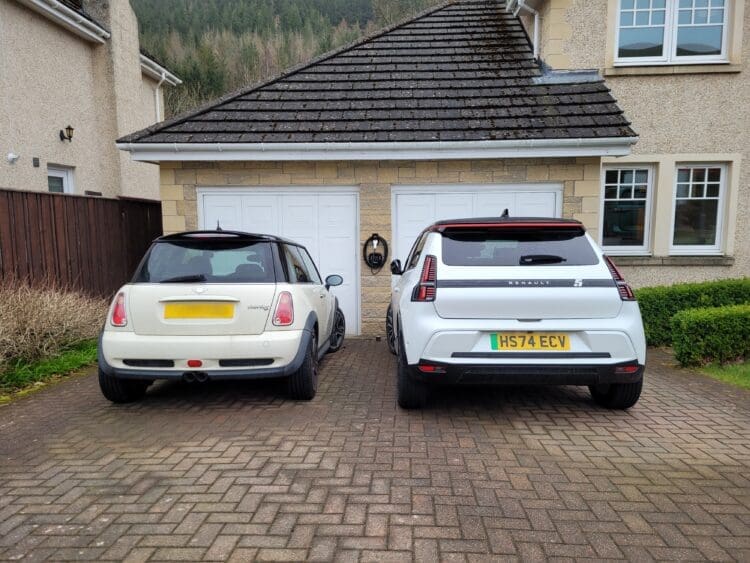
The first generation of BMW Mini was criticised for being too big to be called a Mini. Now, we call the Renault 5 a supermini and hail it as a shining example of the new small car, but it absolutely dwarfs the Mini. We all know cars are getting bigger but seeing two supposed “compact” cars parked side by side on the driveway reinforces how things have changed in 20 years.
I’ve looked it up, and the Renault 5 is 3.92m long, 1.77m wide and 1.5m tall, and that’s by no means unusual for a B-segment car. The Vauxhall Corsa isn’t as tall but it’s even longer and just as wide, as is the Citroen E-C3. Even the current Mini Electric is 3.85m by 1.75m. The old Mini is barely 3.6m long and 1.68m wide.
Yet, there doesn’t feel like there’s a whole lot more space inside the Renault. As a tall driver, I’ve got plenty of room and adjustment but behind me the rear seat is effectively useless, just like in the Mini. And, despite having three rear seatbelts, there’s little hope of fitting more than two people in the back seat.
In fairness, the Renault’s boot is twice the size of the Mini’s and it’s got 20 years’ worth of safety innovation and crash protection, but it comes to something when a “small” car almost fills a supermarket parking space.

It’s no wonder car makers think there’s space below the current crop of superminis for smaller cars like the upcoming Twingo and Kia EV1. It’s encouraging that they also think there’s money to be made there.
Manufacturers started off making larger electric models because that’s where the profit margins were biggest. No doubt that’s still the case, but cars like the Renault 5 and the next crop of even smaller, cheaper models show the technology has developed far enough and dropped enough in cost to make affordable EVs a reality, not a pipe dream.
Long-term log
- Arrived: January 2026
- Price as tested: £30,045 (excl. ECG)
- Mileage since arrival: 1,628
- Average consumption: 3.4m/kWh
- Monthly charging costs: £30.24
- Costs: None
- Faults: None
Month 2 – living up to the hype
Another week and another award for the Renault 5.
This time it has scooped the overall title of UK Car of the Year, making it 45 national and international awards in just over a year.
And it’s easy to see why. A couple of months into our stewardship and my fears that perhaps it won’t live up to the hype have proved unfounded.
The R5 has fitted perfectly into our family life, carrying out the basic “second car” tasks with charm and capability. In fact, it has become something of a battleground in the Allan household. My wife is constantly trying to bag it as her commuter car while I want it for the day-to-day ferrying of our kids around, as well as my frequent trips to Edinburgh.
We’re not quite at the stage of hiding the keys from each other, but we’re not far away.
The fact is, for so many tasks it’s the better choice than our massive ID Buzz family car. Whether it’s nipping to the shops, fighting our way through town, or negotiating an airport car park, the 5’s small footprint, agility and responsiveness make it a pleasure to use. And, as long as there are only two or three of us, there’s enough space for it to act as a family car. Just don’t expect to get anyone behind a taller-than-average driver, and forget about fitting three people in the back seat. It’s not going to happen.

Both of us were left bereft when the car was briefly whisked away to have its annual service done, but it was back with us quickly and – very briefly – clean. The only downside was that the garage reset the trip computer, so my carefully laid plans to get a long-term real-world efficiency figure have been dented. Still, things are looking up.
The start of this month was much like the last one, with temperatures close to zero and efficiency around 2.5m/kWh, which is pretty poor. The good news is that recent weeks have seen the mercury rising and efficiency doing the same. Post-service, I’m seeing around 3.5m/kWh, which should mean more than 200 miles on a charge.
This month I also finally managed to get the MyRenault app to speak to the car. In my previous Scenic long-termer this took about 30 seconds and worked flawlessly. With the R5 it has taken me weeks to figure out that a previously used profile was blocking me from connecting things properly.
Now that it’s working I’ve got access to all the remote controls that make EV ownership so easy. I can check charge and range status with the press of a button, pre-programme the car to be heated for an early morning departure, or activate it on the fly when we’re out and about.
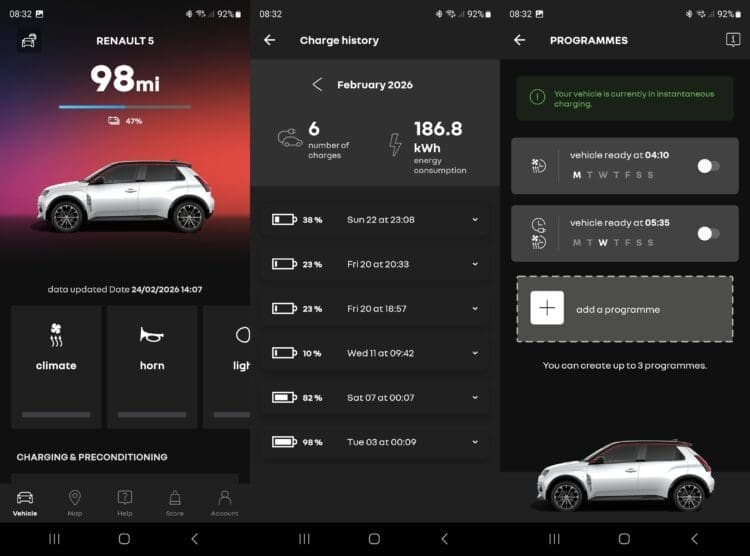
I can even track my charging history, which is great for calculating running costs. So far this month, it’s cost me £15 to cover around 500 miles, equivalent to about 3p per mile. A Renault Clio hybrid returning its official 64mpg would have cost more than £45, so another win for electric power.
Long-term log
- Arrived: January 2026
- Price as tested: £30,045 (excl. ECG)
- Mileage since arrival: 747
- Average consumption: 2.9m/kWh
- Monthly charging costs: £14.94
- Costs: None
- Faults: None
Month 1
The Renault 5 has been a sensation for Renault. It’s won just about every automotive award under the sun, blowing away journalists left, right and centre.
Its combination of sharp design, smart packaging and well-judged powertrain combined with remarkable value have won it plaudits including the European Car of the Year, Scottish Car of the Year, UK Small Car of the Year and Which? Best Buy, as well as rapidly drawing in buyers looking for a small, stylish and affordable EV.
But what’s it like to actually live with? Can it maintain its initial charm in day-to-day life or will cracks start to show in its cheeky charm?
There’s only one way to find out…
Renault offers the R5 with two motor/battery pairing and in four trims ranging from the entry-level £21,495 Evolution with a 118bhp motor and 42kWh battery to the £26,945 Roland Garros+ with the 148bhp motor and larger 52kWh.
I had hoped to test the Techo+ trim with the more potent powertrain but schedules and availability mean I’ve had to settle for the higher-spec Iconic Five+. Oh dear, what a pity…
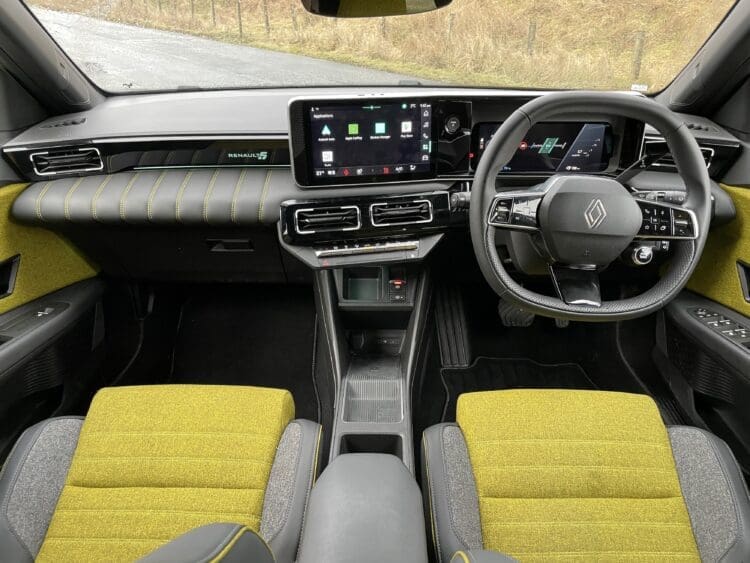
Being an Iconic 5+ spec means ‘my’ R5 misses out on the funky Green or Yellow Pop paintwork of the Techno trim, which draws even more attention to this already attention-grabbing car. Instead, mine comes in a more mature white with a black contrast roof. It’s not as exciting as the vibrant Techo+ hues but still really suits the car’s sharp angles, which blend modern sensibilities with clear callbacks to the original supermini.
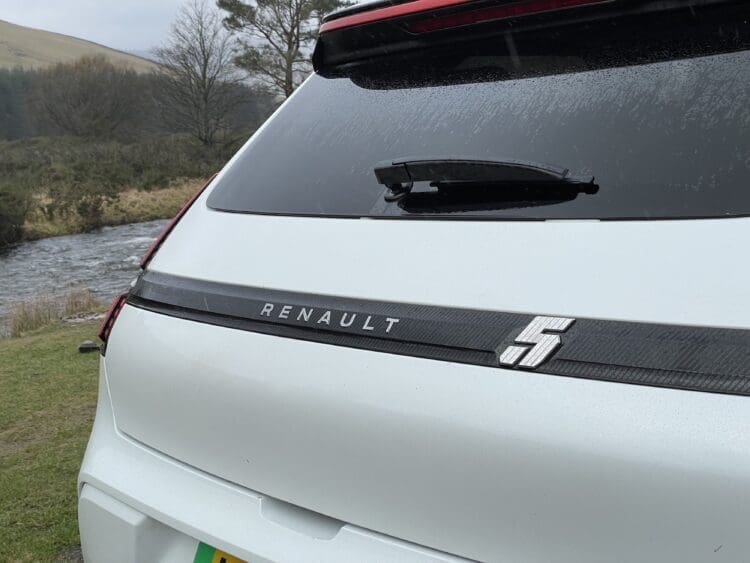
Also, while it’s not as eye-catching as the Techno models, the Iconic 5 spec does mean I get heated seats and steering wheel, which are far more welcome in these chilly months.
On that subject, the car arrived slap-bang in the middle of a cold snap and the first few weeks haven’t been much kinder. Temperatures have never got beyond single figures and at their worst have plummeted to -7 degrees. As we all know, cold weather isn’t kind to EVs and the little R5 is finding the Scottish winter hard going.
According to WLTP testing, this car has an efficiency of 4m/kWh and a range of 251 miles. At the moment, I’m seeing an average of 2.4m/kWh and closer to 140 miles predicted on a full charge.
Admittedly, I haven’t been preconditioning the car and it has been subject to a lot of short runs on very cold mornings, but it does mean the R5 currently feels very much a ‘second car’. It’s coping fine with the local tasks and runs to the airport but needs to be charged a lot more frequently than my recently departed Scenic, and isn’t the default car of choice for every journey.
I’m hoping as the months roll on and the temperature increases we’ll see a marked improvement in efficiency and range.
I’m also hoping that better weather will mean I don’t have to clean it so often – the curse of a white car in winter…
Renault 5 Iconic 5+
- Price: £28,995 excluding ECG (£30,045 as tested)
- Powertrain: Single-motor, front-wheel-drive
- Battery: 52kWh
- Power: 148bhp
- Torque: 181lb ft
- Top speed: 93mph
- 0-62mph: 7.9seconds
- Range: 251 miles
- Consumption: 4m/kWh
- Charging: up to 100kW
Long-term log
- Arrived: January 2026
- Price as tested: £30,045 (excl. ECG)
- Mileage since arrival: 283
- Average consumption: 2.4m/kWh
- Monthly charging costs: £8.49
- Costs: None
- Faults: None


