We take a first drive in the Mazda 6e to see if the Japanese brand’s second attempt at an all-electric model can hit the mark
Mazda hasn’t had the easiest time in the electrified era.
It was slow to respond to Europe’s growing demand for EVs and its first effort was a bit of a dead duck. Rightly or wrongly, drivers didn’t buy into the “right-sized” battery argument that left the MX-30 with a laughably poor range and slow charging.
So for its second EV attempt, Mazda is going more mainstream. The new 6e takes a more competitive approach to powertrains and is pitched at the same sort of SUV-agnostic premium buyer as the Polestar 2, BMW i4, Hyundai Ioniq 6 and BYD Seal.
Where it deviates from the norm is that it’s not 100% a Mazda. Given its relative lack of EV experience, the Japanese brand has turned to Chinese automotive giant Changan for some help. So the 6e is based on the existing Deepal S03 and is built in Nanjing by Changan.
But is that a help or hindrance to Mazda’s attempt to make up lost ground? We’ve had an early drive in one to find out.
It’s worth noting that the car tested was a Swiss-spec model and that some elements may (and hopefully will) change ahead of the full UK launch next year.
Mazda 6e design, interior and technology
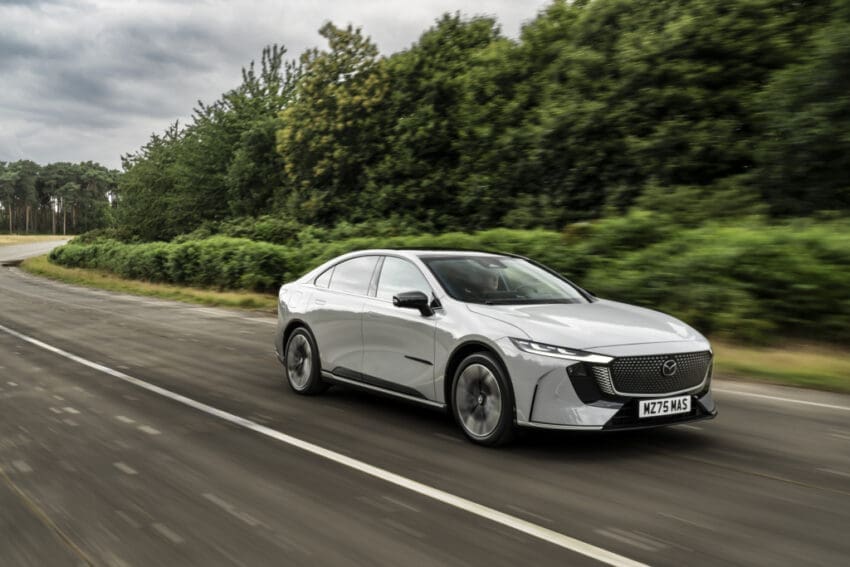
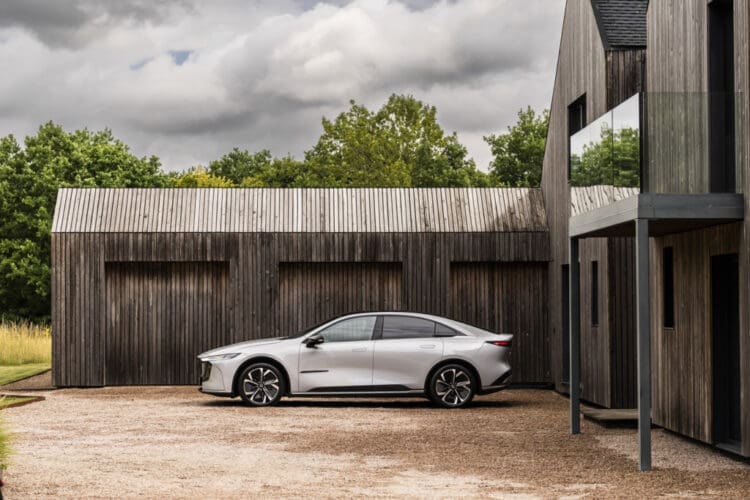
At first glance, there’s nothing to suggest this isn’t 100% a Mazda. Despite similarities with the S03, the 6e bears a clear resemblance to the previous Mazda 6.
From the long low bonnet to the cheeky little ducktail rear with its adaptive spoiler, the 6e has a sleek flowing look that honours the brands’ dedication to simple smooth design. While it looks like a saloon, the 4.92m 6e is actually a hatchback, with a tiny 330-litre boot beneath its powered tailgate. There’s also a 72-litre frunk hidden behind the smooth grille with its elaborate light signature.
Inside things feel a little less Mazda. Components such as the drive selector are shared with a host of other Chinese EVs, and there’s a feeling that less care has been taken than you get in a car designed and built in Hiroshima.
The dashtop “leather” looks and feels cheap, as do the striped plastic elements on the centre console that try (and fail) to give the impression of texture. Even the faux-metal air vents look and feel less premium than your usual Mazda.
More positively, there’s plenty of space on board for four adults thanks to the long wheelbase. The driver’s seat is slightly high-set but even with a tall diver on board there’s ample rear legroom and a standard-fit panoramic roof doesn’t affect headroom.
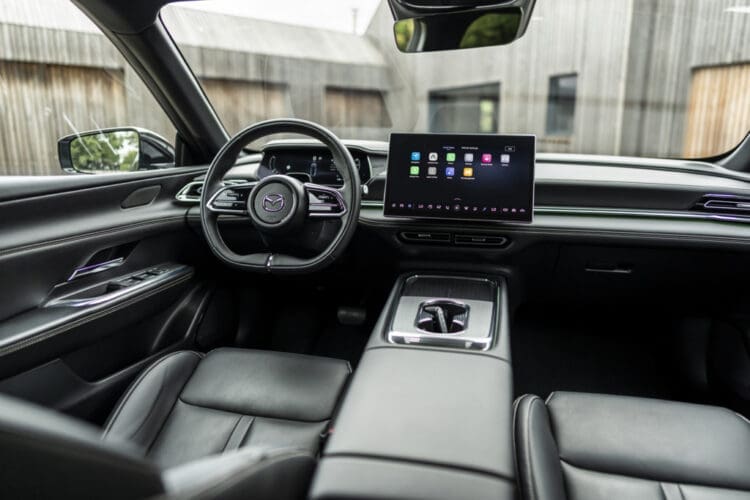
One clue to this car’s Chinese roots is the lack of physical controls. Virtually every function is managed via a 14.6-inch touchscreen.
The screen isn’t the worst of its kind, nor is it the best. There are customisable shortcuts docked to the lower section so things like climate control can be quickly accessed and you can have some say in what’s housed there.
But there are some ridiculous choices. Adjusting the wiper speed or headlight modes have to be done via the screen, as do your wing mirrors and boot release. Given Mazda’s usual focus on ease of use, such stupidity feels out of place.
Likewise when it comes to the litany of poorly calibrated driver “aids”. As is often the case with Chinese-built cars, these require multiple screen taps and menus to adjust – a minimum of five in this case. In addition, beyond the main home page the menu structure isn’t as clear, concise or easy to navigate as the best examples from European or Korean rivals.
Battery, motor and performance
While its first EV was mocked for its single, short-range powertrain, Mazda is making more of an effort with the 6e. It offers two motor and battery options with up to 254bhp and 343 miles of range. Both are reasonable but not outstanding for the class.

Unlike most rivals, the more powerful version of the 6e comes with the smaller battery. Even more confusingly, this is also the battery with the faster charging rate.
Opt for the 254bhp variant and you’ll get a 68.8kWh LFP battery with peak DC charging of 165kW. That’ll manage 300 miles of range and charge from 10-80% in 22 minutes. It will also crack 0-62mph in 7.6 seconds – just 0.2 seconds quicker than the less-powerful car.
For maximum range, you’ll need the 241bhp model, which comes with an 80kWh NMC battery. This offers up to 345 miles but charging is capped at just 90kW, meaning the 10-80% charge takes a glacial 45 minutes.
For reference, the comparable long-range Polestar 2 peaks at 205kW and takes 28 minutes while the Ioniq 6 takes just 18 minutes at 350kW.
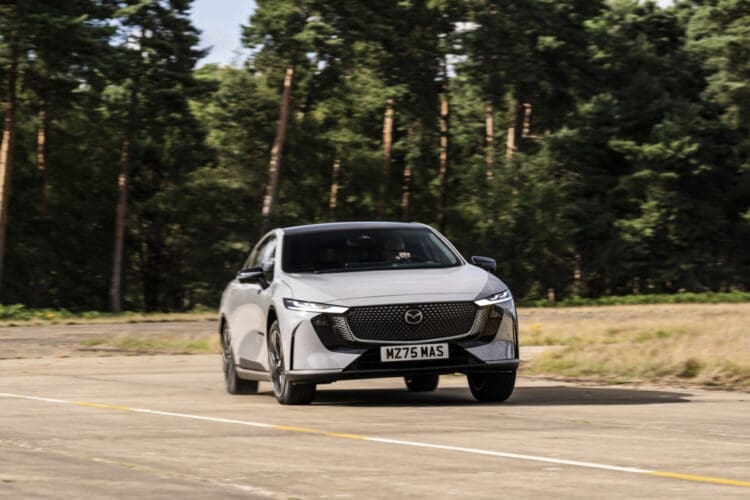
I only tested the 241bhp motor which still felt punchy enough. Power comes on smoothly and steadily, with strong but composed low-down pull that continues right up to motorway speeds. That’s balanced by well-calibrated linear braking, although the four-stage regen never feels quite powerful enough and there’s no one-pedal option.
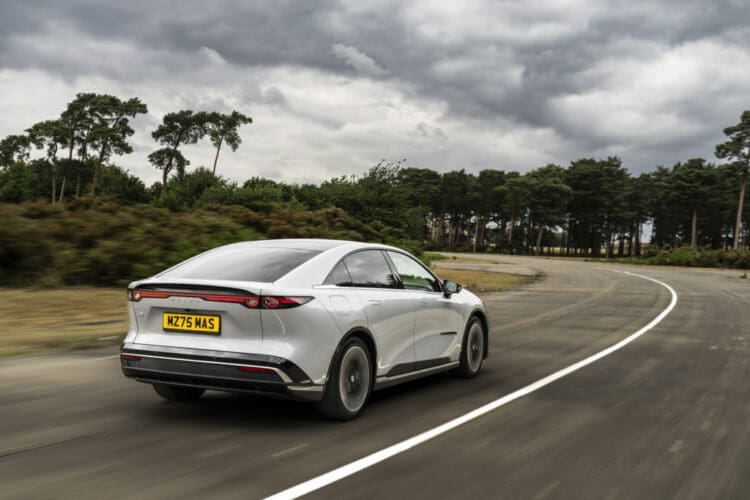
As mentioned, our test cars were Swiss-registered and while the 6e’s ride might be fine on those snooker-table-smooth roads, it’s simply not good enough for the UK. There is an ever-present chatter transmitted from the road into the cabin that leaves passengers feeling constantly jostled around and the car feeling permanently unsettled.
The chatter from the ride is in direct contrast with the lack of communication from the steering. Mazda usually prides itself on the connection between car and driver but that’s entirely missing here. Three drive modes adjust throttle response and steering weight but do nothing to bring any sensation to the overly light system. Mazda can point to the rear-wheel-drive similarities with the MX-5 but this is no MX-5. It’s not even a CX-5.
Mazda 6e price and specifications
Pricing for the Mazda 6e is still some way off. The first UK cars aren’t expected until mid-2026, so full specs and prices will be confirmed closer to then.
What we do know is that in Germany, the 6e is priced from €44,990. That’s around €1,000 more than an entry level Polestar 2 and €3,000 more than a basic BYD Seal.
In the UK those two models start at £43,160 and £45,705 respectively, so we would expect the Mazda 6e to start at around £45,000.
We also know that there will be two trim levels – Takumi and Takumi Plus – and that all cars will feature premium kit such as adaptive LED headlights, 19-inch alloys, a panoramic roof, augmented reality head-up display and multi-zone climate control. Takumi Plus cars will also get tan Nappa leather in place of the black faux-leather of the Takumi grade.
Verdict
I came away from the Mazda 6e slightly disappointed.
It might look like a Mazda from the outside but it doesn’t feel like one. To be blunt, it feels like a Chinese knock-off of a “proper” Mazda.
The brand’s appeal has always been its user-friendly, high-quality interiors and a superior driving experience compared with rivals. But the 6e doesn’t deliver either.
The interior isn’t bad but nor does it stand out in the way we’ve come to expect. Likewise the dull driving experience is on a par with the Ioniq 6 or Seal but some way off what the Mazda badge promises.
There’s still time for Mazda to fix the ride and handling before right-hand-drive cars arrive in the middle of next year. If it can do that then the 6e will at least have some glimmer of the old Mazda magic but for now it feels distinctly average among some tough competition.
Mazda 6e Takumi
- Price: TBC
- Powertrain: Single-motor, rear-wheel-drive
- Battery: 80kWh
- Power: 241bhp
- Torque: 236lb ft
- Top speed: 108mph
- 0-62mph: 7.8 seconds
- Range: 343 miles
- Consumption: 3.77m/kWh
- Charging: up to 90kW