


The third-generation Jeep Compass gets an all-electric option for the first time but is it enough to stand out among talented rivals?
Think Jeep and it’s likely the iconic Wrangler or the massive Grand Cherokee will spring to mind.
But there’s more to the brand, especially in Europe, where it has offered a variety of smaller, more understated models to meet our (dare I say it) more sophisticated tastes.
Central to that family of road-focused models is the Compass – a C-segment sized SUV that has sold more than 2.5 million units since it launched in 2006.
In that time we’ve had two versions of the Compass, but the most recent arrived in 2021 and since then the competition has moved on in terms of space, technology and powertrains.
So to stay competitive with the likes of the Ford Explorer, Renault Scenic and newly arrived Toyota C-HR+, as well as related models such as the Vauxhall Grandland and Peugeot 3008, Jeep has set out to make the Compass bigger and better.

That’s involved a completely new design, all-new interior and, for the first time, the addition of an all-electric powertrain. But with the C-segment representing the industry’s biggest and most competitive, has it done enough to plot a course for success?
Design
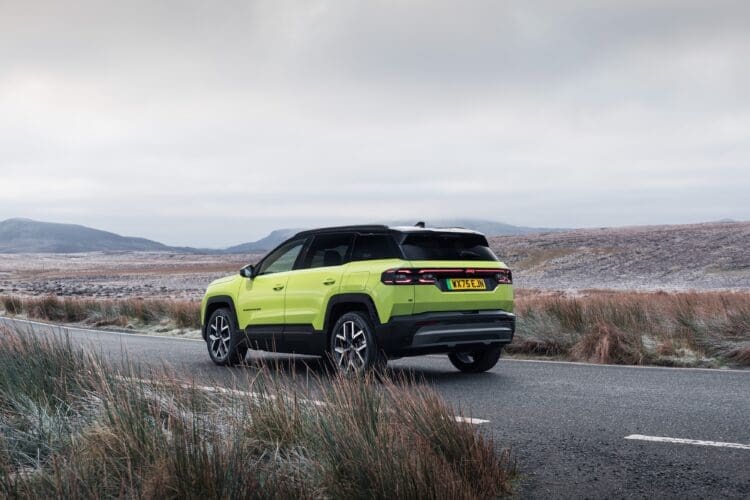
The Compass is clearly the big brother to the Avenger and has the look of a car designed for Europe rather than the US. That’s because it’s the work of the same Turin-based design team as the Avenger and follows its theme of boxy, bluff but not too aggressive.
The muscular squared-off design works well in giving the Jeep a character that’s very distinct from other cars on this platform and ties into Jeep’s rugged roots. There are callbacks to Jeeps of the past – from the slatted faux-grille to the trapezoidal wheel arches – plus scores of Jeep-specific easter eggs. There are also practical touches such as the scratch-resistant lower cladding and short overhangs that give best-in-class ramp-over angles (in case you fancy some light off-roading).

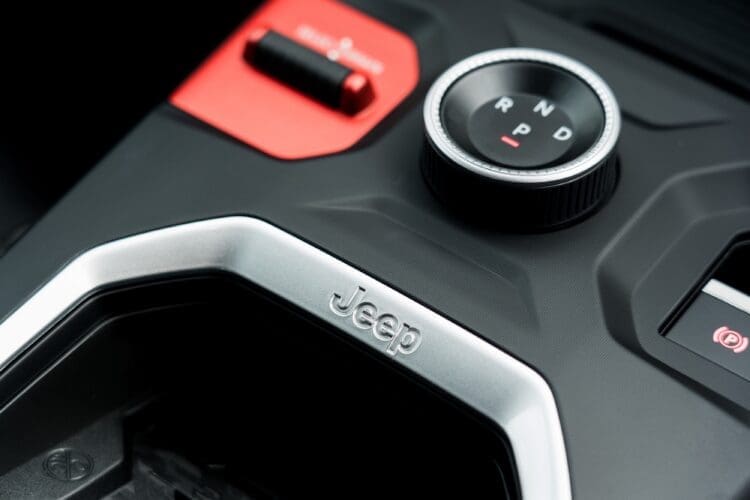
The interior design team has done a similarly good job of making the Compass feel different from its stablemates. There’s a pleasing simplicity to things and some nice bespoke touches – from the rotary drive selector to the big red surround for the Selec-Terrain drive mode switch. Those controls, along with several other surfaces, has a rubberised finish that buyers will love or hate but that ties into Jeep’s outdoorsy aesthetic. The hard-wearing fabric and vinyl upholstery is another nod to the brand’s more rugged outlook. It’s just a shame so much of the interior is dull grey and silver.
Storage is a big deal for Jeep, so there are heaps of little cubby spaces – from the open dashboard shelf to two deep bins in the centre console. And there’s a 550-litre boot with a two-level floor board, and the rear seats fold 40/20/40 for added flexibility.
Space in those seats is decent enough. There’s good rear headroom thanks to the upright SUV shape and legroom is close to most rivals, although nothing spectacular for the class. A flat floor and wide body means you’ve a decent chance of fitting three people abreast in the rear.
The front is similarly spacious, with supportive comfortable seats finished in two-tone fabric and embossed with the Jeep logo.

Ahead of the driver is a big, bright digital instrument display, while all the infotainment is handled by a 16-inch central screen, set high up in the dash. It’s quick and clear and there’s a handy line of shortcut keys beneath it. However, like other models on this platform, it’s easy to get tied up in menus navigating between functions.
Battery, motor and driving
The Jeep Compass is launching with just one all-electric powertrain, with additional variants to come.
They include a long-range model capable of more than 400 miles on a charge, and a 370bhp four-wheel-drive version with a smattering of off-road-friendly modifications.
But, for now, we’ve got the standard range front-wheel-drive to play with. This uses a 74kWh battery and a 210bhp motor which puts it within a few horsepower and a few kWh of most of the mainstream C-SUV class.
Range from that battery is 310 miles. That’s enough for most people, but some way short of some rivals, which offer between 350 and 380 miles. If range is super-important, the 98Wh version will arrive later this year.

Although it’s not as powerful as some rivals, the Compass manages to get from 0-62mph in 8.5 seconds, which is perfectly acceptable for the class. Not that that it feels immediately sprightly. There’s a sponginess to the throttle and brake pedal that speaks of a car set up more for comfort. Sport mode helps bring sharper response and adds a bit more directness to the otherwise slightly vague steering.
Like the styling, Jeep has managed to set the Compass up to feel different on the road from its Stellantis relatives. It sits somewhere between the overly stiff 3008 and the super-squishy C5 Aircross in comfort and handing. Body roll is fairly well managed and big lumps and bumps are dealt with well but there’s a chatter to the ride that means it lacks the composure of a Skoda Elroq or C-HR+.
Price and specification
With just one powertrain and two trim levels, the Jeep Compass range is blessedly simple.
The model is priced from £36,995 while the First Edition is £39,200.
Unfortunately for Jeep, the Compass hasn’t yet been approved for the Government’s Electric Car Grant, whereas several rivals have been. That might change – the Grandland and C5 Aircross which use the same batteries are eligible – but for now, it leaves the Jeep looking a little pricey compared with an Elroq, C-HR+ or Scenic.
Altitude models include 19-inch alloy wheels as standard and come with heated front seats and steering wheel, front and rear parking sensors, adaptive cruise control, digital instruments and the 16-inch touchscreen with built-in navigation plus wireless Android and Apple mirroring.
First Edition upgrades the wheels to 20-inch designs and adds adaptive LED headlights and an illuminated grille, plus tinted rear glass. Additional equipment includes a powered hands-free tailgate, heat pump, reversing camera and wireless phone charging.
Features such as a 360-degree parking camera and blind spot monitoring, which are standard on some rivals, also only come as part of paid-for options packs.
Verdict
A slightly stingy spec and uncompetitive pricing could be the Compass’s downfall.
Jeep has done a good job of making it look and feel distinctive enough from its Stellantis stablemates, and the basic powertrain is fairly competitive for the segment. It’s also a perfectly nice thing in which to cover the miles.
But there’s nothing remarkable about it and it’s fighting for attention in a crowded market where rivals can offer more for less.
Jeep Compass Altitude
- Price: £36,995
- Powertrain: Single-motor, front-wheel-drive
- Battery: 74kWh
- Power: 210bhp
- Torque: 253lb ft
- Top speed: 112mph
- 0-62mph: 8.5 seconds
- Range: 290 miles
- Consumption: 3.34m/kWh
- Charging: up to 160kW
Also consider
- Skoda Elroq – A brilliant all-rounder with a broader range of options
- Citroen E-C5 Aircross – Same powertrain, more space, more comfort and all for less money
- Renault Scenic – Lacks the Jeep’s rugged styling but offers better range and more intuitive user interface


