
Public EV charging now cheaper than petrol for most drivers
Soaring fuel prices caused by the Iran war mean EV owners are better off than petrol or diesel drivers even if they only ever use public chargers.
An analysis of the latest figures from ChargeUK shows that as a result of recent fuel price volatility, the per-mile cost of running a petrol or diesel car has overtaken the cost of EV charging in almost every scenario for the first time since May 2024.
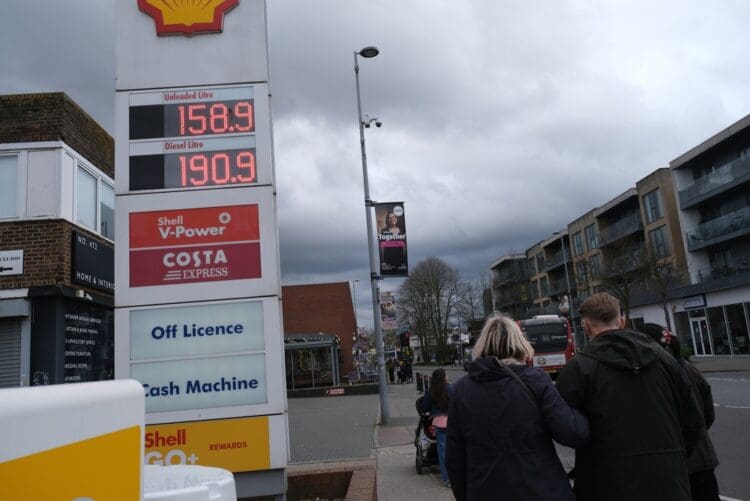
The Iran war has seen petrol and diesel prices increase by around 20% in recent weeks while EV charging has remained relatively stable.
ChargeUK’s analysis of data from Zapmap and RAC Fuel Watch shows that when charging solely on a “standard” charger – such as on-street or in a local car park – at the national average of 54p per kWh drivers can expect to pay around 15p per mile. In contrast, petrol drivers are currently paying an average of 17p per mile while diesel drivers pay 17.5p per mile.
Based on using standard chargers 80% of the time and more expensive rapid chargers 20%, EV owners would pay around 16p per mile. Only those relying 100% on rapid/ultra-rapid devices, which cost an average of 76p/kWh, are worse off – paying 21p per mile.
At current rates and over an average annual mileage of 7,100, an EV driver relying on standard chargers or a mix of standard and rapid will save between £32 and £119 per year compared to petrol drivers.
Those who have at-home charging continue to enjoy massive savings of up to £1,000 per year thanks to running costs as low as 2p per mile.
Average UK charging/fuelling costs
| Pence per unit (kWh and litres) | Pence per mile | Cost over 7100 miles | Savings vs petrol | |
| Home off peak | 8 | 2.23 | £158 | £1,029 |
| Home price cap | 24.7 | 6.88 | £488 | £699 |
| Average rapid/ultra rapid | 76.00 | 21.17 | £1,503 | -£316 |
| Average standard/standard plus | 54.00 | 15.04 | £1,068 | £119 |
| 80% / 20% standard/rapid | 58.40 | 16.27 | £1,155 | £32 |
| 80% / 20% off peak home/rapid | 21.60 | 6.02 | £427 | £760 |
| Average petrol | 157.34 | 16.72 | £1,187 | – |
| Average diesel | 189.88 | 17.40 | £1,236 | – |
| Average petrol – motorway services | 181.13 | 19.25 | £1,367 | – |
| Average diesel – motorway services | 202.85 | 18.59 | £1,320 | – |
Need for long-term action
Until 2021, public charging was cheaper than fuelling a combustion engined vehicle but rapid price increases between then and last year mean the figures have shifted in petrol and diesel.
ChargeUK CEO Vicky Read said the latest changes and the instability of fuel prices reinforced the need for action to make public charging cheaper again.
She said: “While this is not how we wanted to see the gap between public EV charging and petrol prices closed, it once again demonstrates the urgent need to make driving an EV more affordable for all.”
While fuel prices may fall again, ChargeUK is calling on the Government to take action to ensure that EV charging remains cheaper in the long term.

Read added: “We need to see Government take control of the situation to ensure the numbers stack up not just in a time of global crisis, but for the long term. The cost pressures currently pushing up public EV charging prices are largely within the government’s grasp, whereas the global pressures pushing up petrol and diesel prices are not.”
She repeated calls to address uncapped standing charges and to cut VAT on public charging. The Government recently announced it was appealing against a tribunal ruling which declared that public charging should be subject to the same 5% VAT as domestic charging, rather than the current 20%.
Simon Williams, the RAC’s head of policy, added his calls for a rethink on charging tax.
He commented: “While the dramatic increase in petrol and diesel prices due to the conflict in Iran has understandably sparked increased interest in going electric, it remains the case that public charging costs are higher than they need to be.
“Issues outside of operators’ control such as 20% VAT on public charging, compared to 5% at home, and high standing charges aren’t helping. We hope the government will seek to address these issues so more people can make the switch to electric driving and charge affordably away from home.”