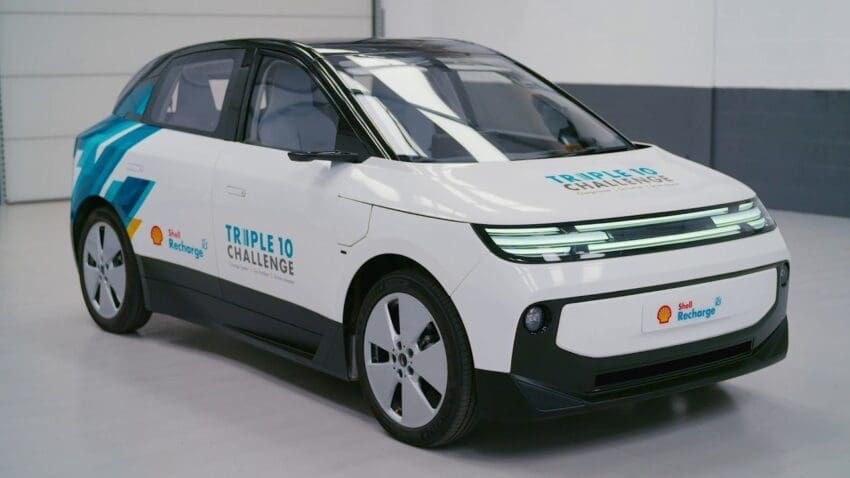
Energy giant Shell has unveiled its Triple 10 Challenge concept car, offering a glimpse of how small EVs of the future could perform.
The Triple 10 Challenge takes its name from its three proposed goals: A 10-minute recharge from a 175kW rapid charge, an efficiency rating of 10 kilometres per kilowatt-hour (6.2 miles/kWh), and lifecycle CO2 emissions of 10 tonnes.
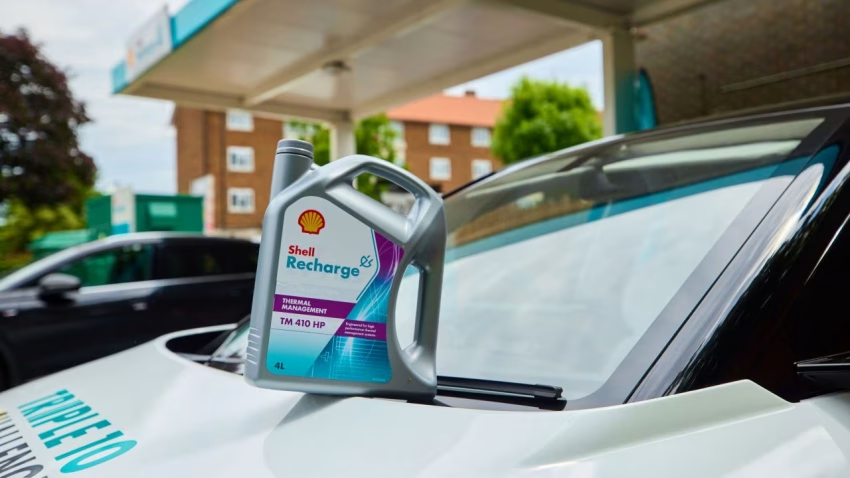
Shell’s thinking behind the project is to show how new automotive technologies can be used by mainstream manufacturers to build more efficient electric vehicles. The Triple 10 Challenge will also use the firm’s EV-only fluids and lubricants, with a view to boosting demand from manufacturers.
The Triple 10 Challenge is powered by a new fluid-immersed battery co-developed with Northampton-based engineering firm, JML.
The new pack uses two banks of cylindrical cells, which are submerged in a non-electrically conductive fluid developed by the oil and gas giant to chill the battery’s cells directly. This approach removes the need to run coolant pipes over the top of each battery module, which is the layout adopted in traditional EV batteries.
Shell believes that immersing the Triple 10’s batteries directly in coolant improves thermal management, as the batteries can run at their optimal temperature almost all of the time.


By removing thermal constraints, the Triple 10 Challenge’s 32kWh battery can sustain a 175kW peak charge rate for the duration of a charging session, promising a 10-80% top-up time of 10 minutes. It is worth noting that most EVs now have a peak charging rate in excess of 300kW, but their cooling systems restrict these numbers to short bursts.
According to Shell, better cooling improves more effective energy recovery from the Triple 10 Challenge’s braking system, which, in turn, creates a virtuous upward spiral across the board.
Better cooling improves electrical efficiency and range, while faster charging reduces range anxiety. Overall, this means manufacturers can use a smaller battery, which reduces weight and cost.
A cooler battery also means it can be connected to the same radiator as the motor and power electronics. This form of shared cooling architecture saves weight, complexity, and cost for OEMs. Additionally, more effective and consistent cooling helps protect against thermal runaway events, reactions caused by a damaged cell that can lead to fire.
The experimental battery tech is believed to improve recyclability and repairability. Instead of using thermal paste, their fluid can be siphoned out into a bucket, and the modules can be pulled out.
Aside from the battery, the Shell Triple 10 Challenge’s environmental credentials are strengthened by the car’s use of more eco-friendly, naturally occurring materials. The chassis is built from recycled aluminium, which is claimed to produce 10% of the CO2 emissions of new ‘virgin’ materials.
Meanwhile, the roof and wheels are made from recycled carbon fibre to keep weight low, while Shell has taken a leaf from Skoda’s book and manufactured parts of the interior from flax.