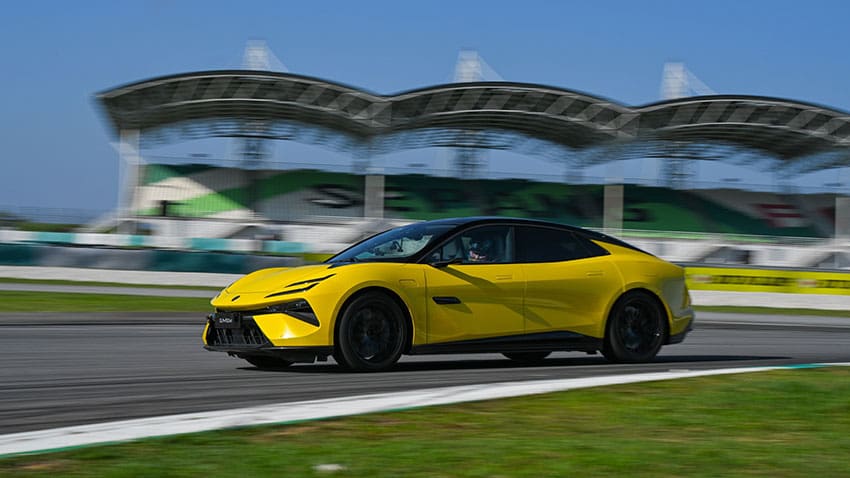
Lotus has claimed a new electric vehicle lap record at Malaysia’s Sepang International Circuit, with its Emeya hyper-GT stopping the clocks at 2 minutes 20.317 seconds.
That time is more than seven seconds inside the fastest publicly reported EV lap previously set at the Formula 1 venue, a 2:27.790, and strengthens the four-door Lotus’ claim to a place at the very top table of electric grand tourers alongside the Porsche Taycan and Audi e-tron GT.
The record run was completed by the flagship Emeya R+ derivative, now more commonly known as the Emeya 900, with champion GT racer Daniel Lu at the wheel. For Lotus, the result underlines the car’s ability to pair everyday usability with genuine track capability.
Sepang is no soft target, either. The 5.5km Malaysian Grand Prix circuit pairs two long, high-speed straights with a demanding mixture of quick and slow corners, testing power delivery, braking, aerodynamic stability and chassis balance in equal measure.
Lotus says the result proves its electric era still carries the firm’s traditional obsession with handling. “At Lotus, the track has always been the ultimate proving ground,” said Chong Yok Meng, senior director for chassis and vehicle dynamics at Lotus.
“Setting the fastest EV lap at Sepang reflects the dedication of our engineering team and our commitment to delivering exceptional driver engagement, precision and performance. For us, this achievement isn’t just about speed. It’s proof that our electric vehicles embody the same dynamic principles that have defined Lotus for generations.”


Records are becoming a habit
The Hethel-based brand is building quite a collection of Emeya bragging rights. The car was previously crowned the world’s fastest-charging production EV, topping up its battery from 10 to 80 per cent in just 14 minutes.
For British buyers, the Emeya arrived with UK pricing and specification announced from £94,950, before Lotus later reshuffled its Emeya and Eletre line-ups with new trim levels and lower prices.
Central to the Sepang result, according to Lotus, is the Emeya’s “porosity”, the aerodynamic philosophy of channelling air through the body as well as under, over and around it. The approach was pioneered on the Evija electric hypercar, carried over to the petrol Emira, and shapes the Emeya’s slippery silhouette today.
Lotus describes the Emeya as a pure electric hyper-GT designed “For The Drivers”, combining class-leading ride and handling with a luxurious cabin intended to work just as well on the school run as on a flying lap.
Whether many owners will ever chase a Sepang time is beside the point. The record is a statement that, even with batteries where a V8 might once have sat, a Lotus is still meant to be driven hard. On this evidence, the message has survived the switch to electric power intact.